What’s inside
- The full two-hour recording: how a file reviewer reads your application, the four kinds of prompt, the evidence method, the eight blocks, assembly, the CV and your referees, and the checks before you submit
- Written as Evidence, 35 pages: the decoder you fill in per school, a worksheet for each of the eight evidence blocks, the clinical experience inventory, the assembly sheet, four exercises and the pre-submission checklists
- What the Programs Ask, 115 pages, built from all 875 program descriptions in the 2027 first iteration: 862 of them ask for a personal letter, and between them they ask 411 different things; 739 list a custom CV as a required document. It quotes every family medicine prompt in the country in full, school by school, plus the largest programs and every differing IMG stream in ten other disciplines: internal medicine, psychiatry, pediatrics, anesthesiology, emergency medicine, obstetrics and gynecology, general surgery, diagnostic radiology, neurology and orthopedic surgery. Other disciplines appear in the country-wide counts and the rules chapters, not as quoted cards
- In that report: the word caps and what happens past them, where each school wants the gaps addendum, the AI rules, and the criterion each program publishes for the letter in its own file review table
- The CV example, a finished CV in the form the session teaches, and the CV template, the same form as a Word file, empty, for yours
- The IMG streams that ask something different are quoted on their own cards, among them UBC, Alberta, Calgary and Dalhousie, which ask for recency, hands-on care and level of responsibility rather than job titles
- Recording access expires 60 days after purchase. The four files are yours to keep
About the author
One page of the 115
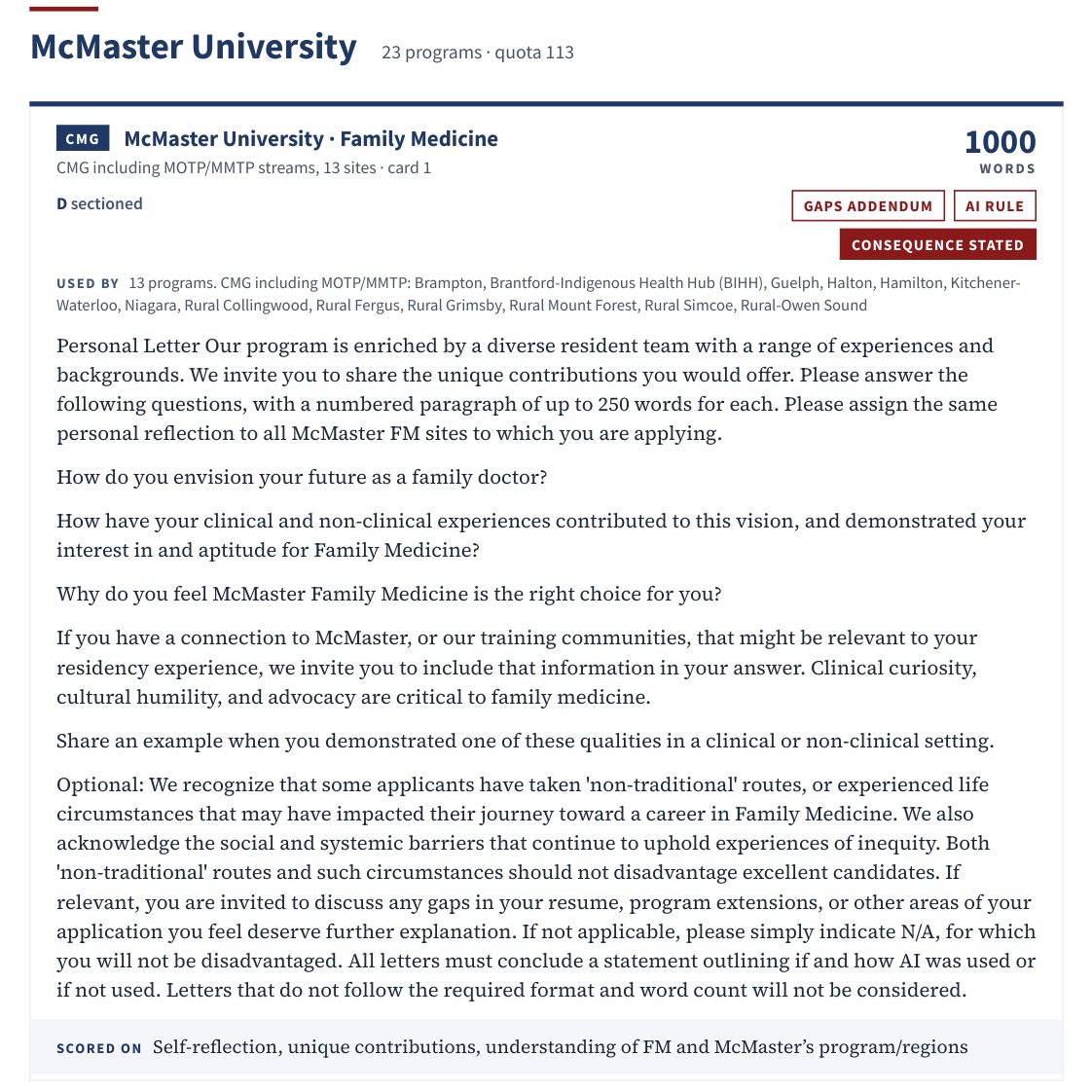
Page 43 of What the Programs Ask, as delivered: the McMaster family medicine card, with the prompt quoted in full, the cap, the addendum and AI rules, and what the program says it scores. Every school in family medicine and the largest programs in ten other disciplines get a card like this.
Questions before you buy
Is my discipline in the report?
Family medicine is complete: every prompt from every school. Ten other disciplines are quoted program by program, largest first: internal medicine, psychiatry, pediatrics, anesthesiology, emergency medicine, obstetrics and gynecology, general surgery, diagnostic radiology, neurology and orthopedic surgery. Every other discipline is in the country-wide counts and in the chapters on caps, addenda, AI rules and scoring, but its programs are not quoted one by one.
Is this for Canadian graduates or for IMGs?
Both. The session teaches one method for the CV and the letter, and the report quotes the prompts of the largest programs in each discipline, which are the ones Canadian graduates apply to, plus every family medicine prompt in the country. Where an IMG stream asks something different, its prompt is quoted on its own card, so an IMG sees exactly what changes for their stream.
What happens after I pay?
Stripe takes the payment and you land on a confirmation page. Within minutes an email from [email protected] brings the recording link with its passcode, the workbook, the report and the CV example as PDFs with your name on every page, and the CV template as a Word file. Nothing to unlock and nothing to register for. It is a digital product and the sale is final.
Why 60 days on the recording?
The recording is a Zoom share. Recording access expires 60 days after purchase, which reaches past the November 26 deadline for anyone buying from September 27 on. The four files have no expiry.
Is the session the same one the live participants had?
Yes. It is the complete recording of the session taught on September 17, 2026, with the same workbook and report the room received. The ratings on this page come from the people who attended live or watched the recording afterwards.