
Master the Path to Canadian Practice
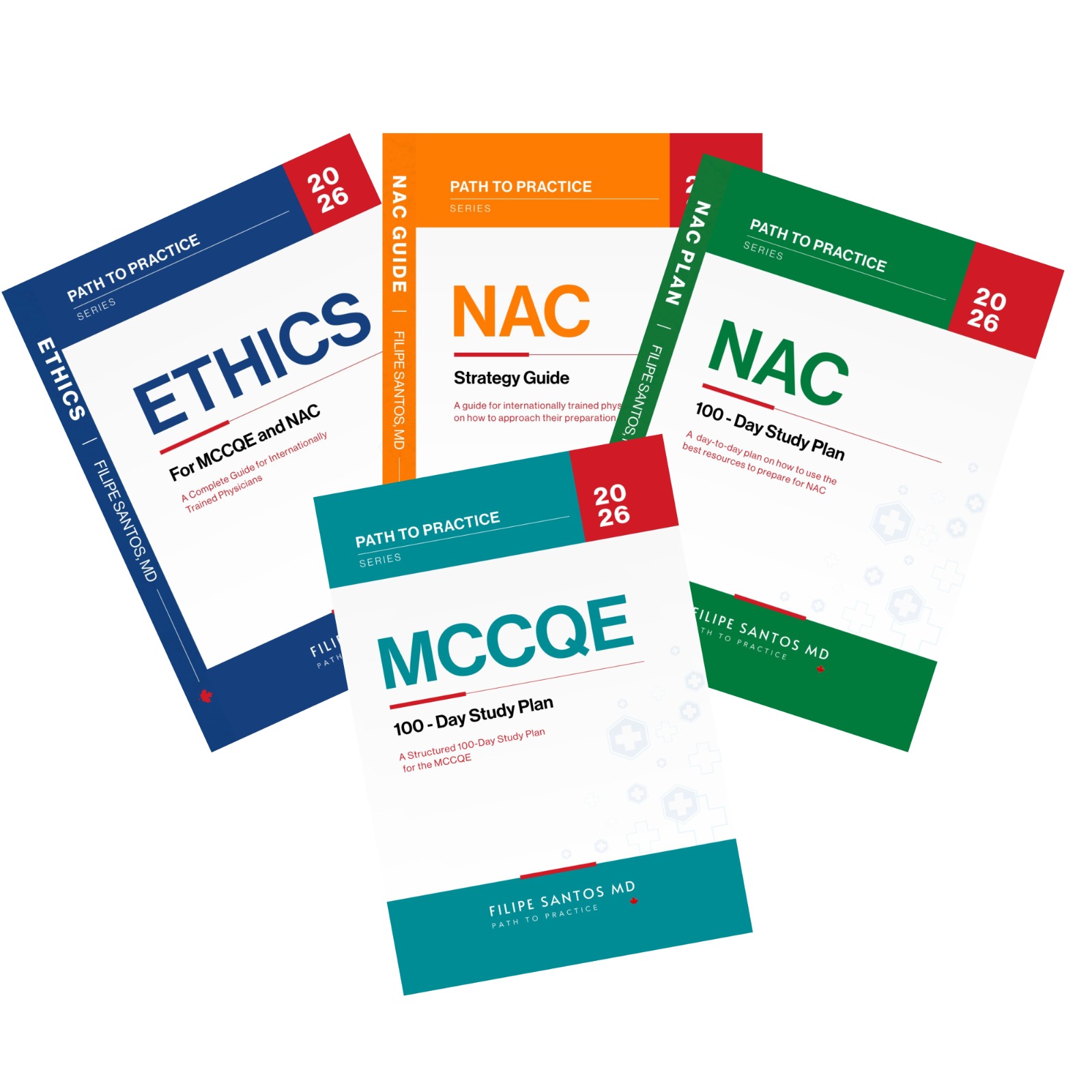
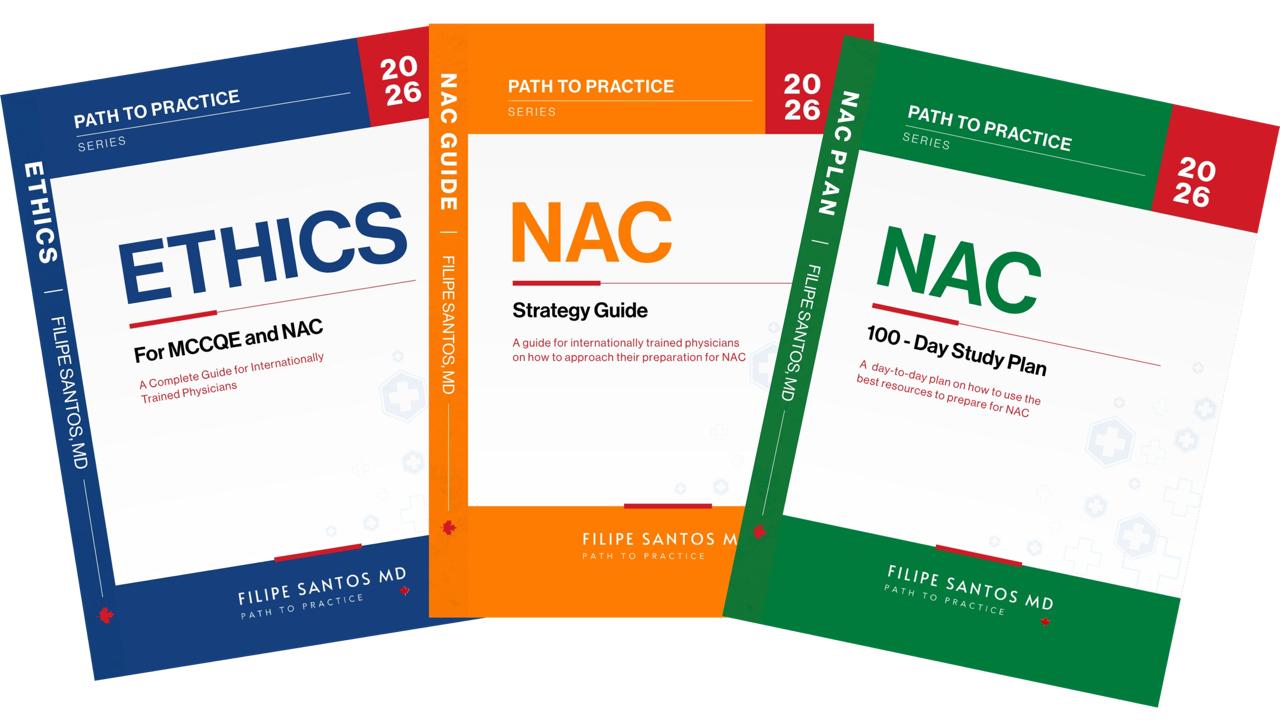
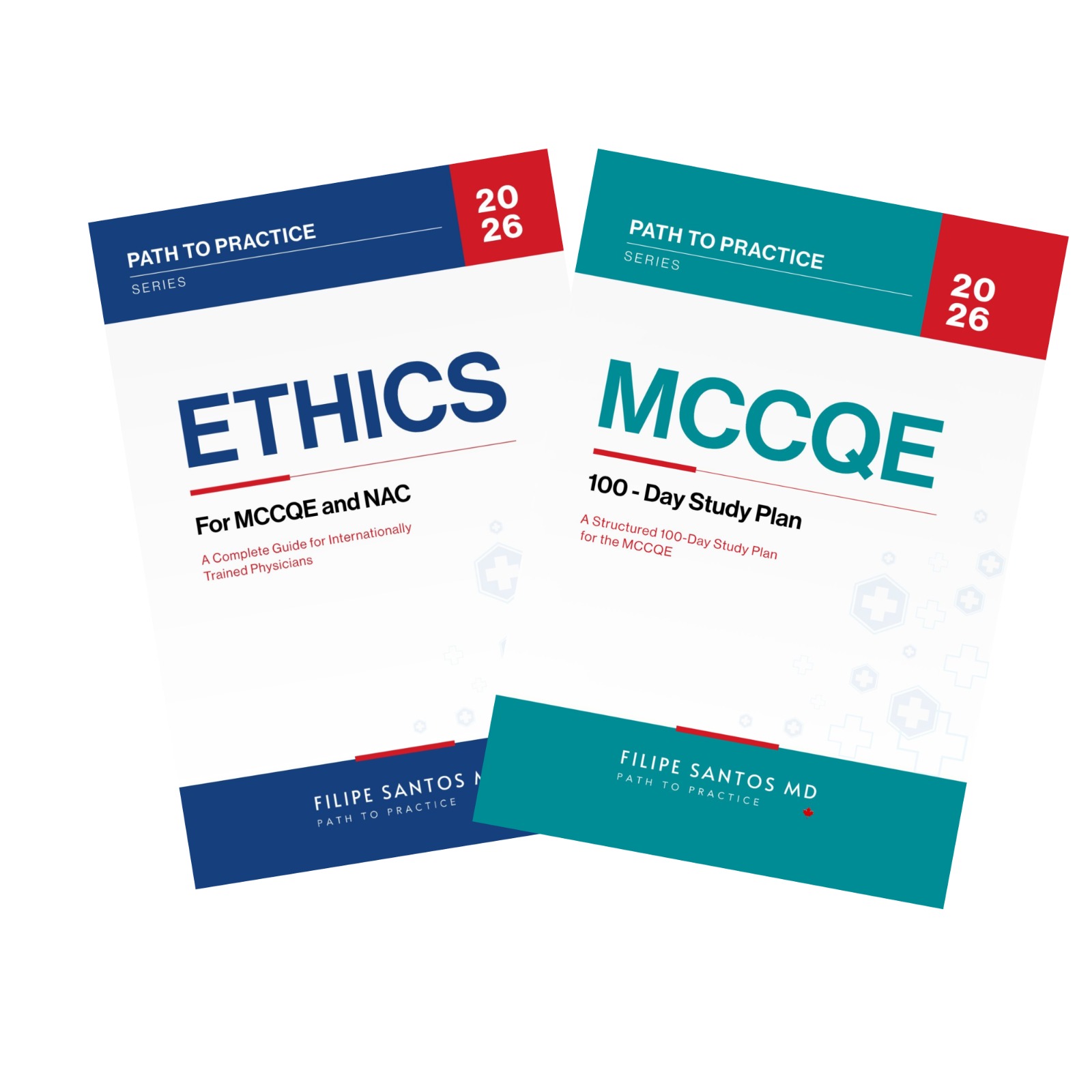
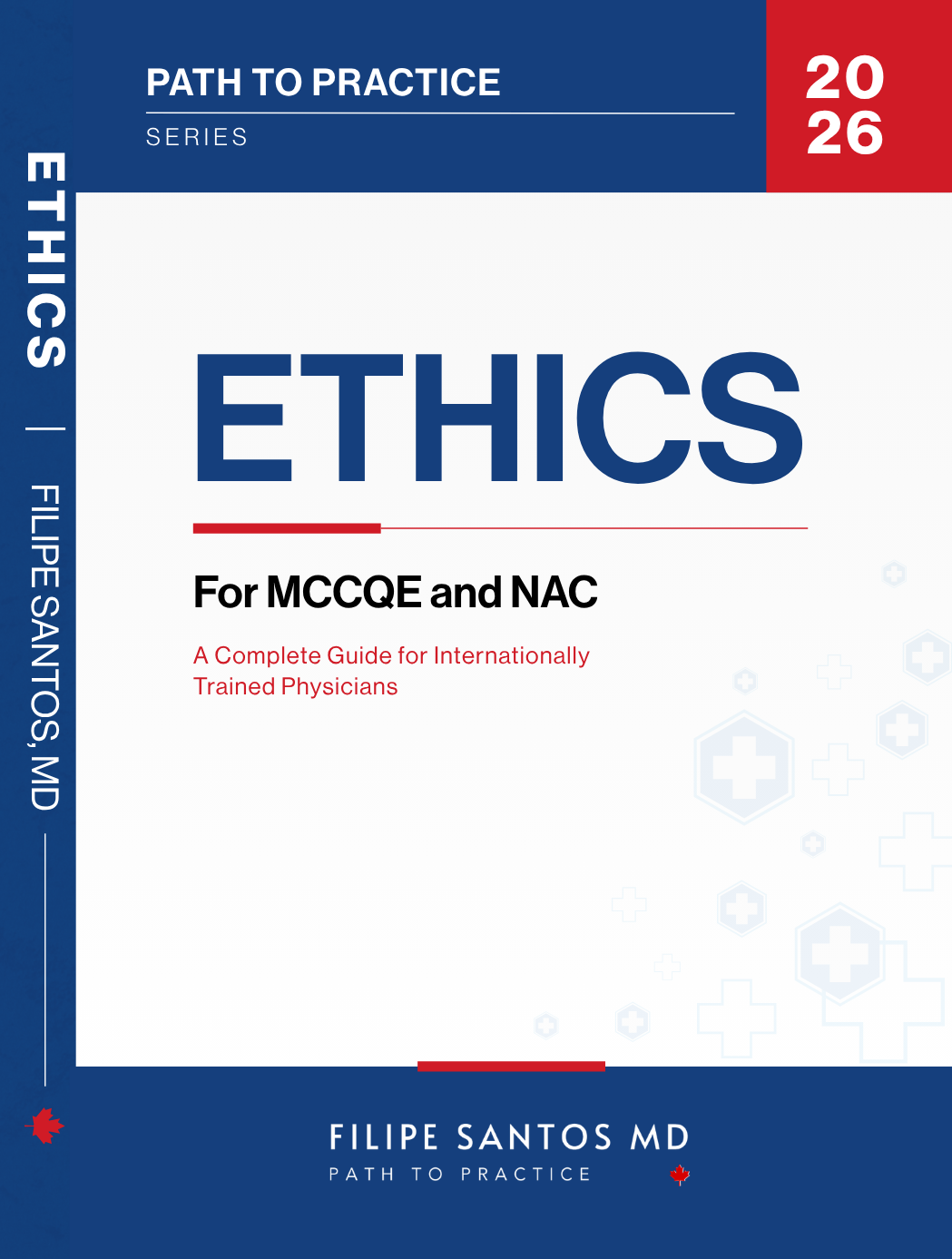
Ethics for MCCQE and NAC
Path to Practice Series, Vol 2
The Canadian rules you weren’t taught.
Ethics is where IMGs lose marks they should not be losing. Not because they don’t know medicine, but because the rules they bring into the exam room are from the wrong jurisdiction.
This guide rebuilds your ethical reasoning for the Canadian context.
♦ 20 testable topics, organized by what the exam is actually asking
♦ “Where Candidates Frequently Go Wrong” callouts in every chapter
♦ Built for both MCCQE Part 1 and NAC ethics stations
$65 CAD | Digital, 7×10 PDF | Instant Access
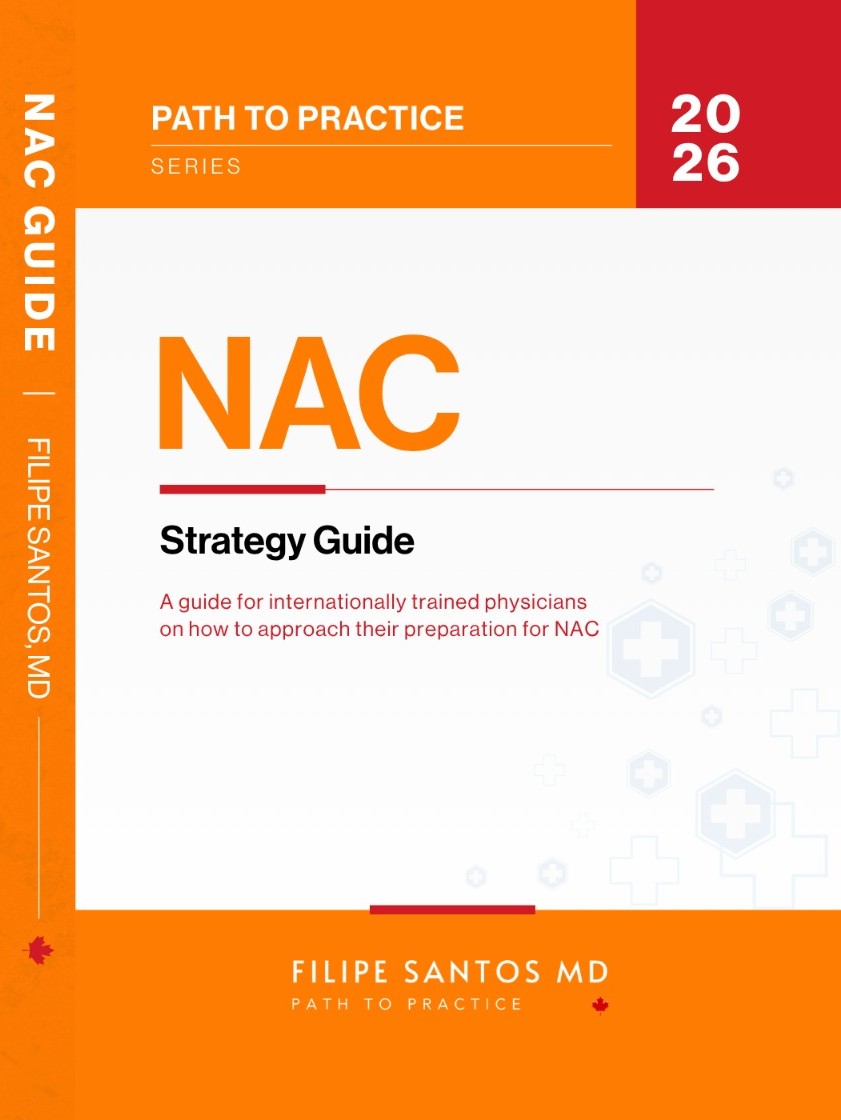
NAC: A Complete Strategy Guide
Path to Practice Series, Vol 1
The NAC is harder than it looks.
Most IMGs prepare for the NAC like it is a knowledge test. It is not. It is a performance exam, scored by Canadian examiners watching for specific cues that most international training never teaches. This guide covers all of them.
♦ Frameworks for every part of the encounter: history, physical, communication, and clinical reasoning
♦ Station archetypes decoded, with the cues that tell you what is being tested
♦ The 7 failure patterns that quietly cost knowledgeable IMGs their pass
$89.99 CAD | Digital, 7×10 PDF | Instant Access
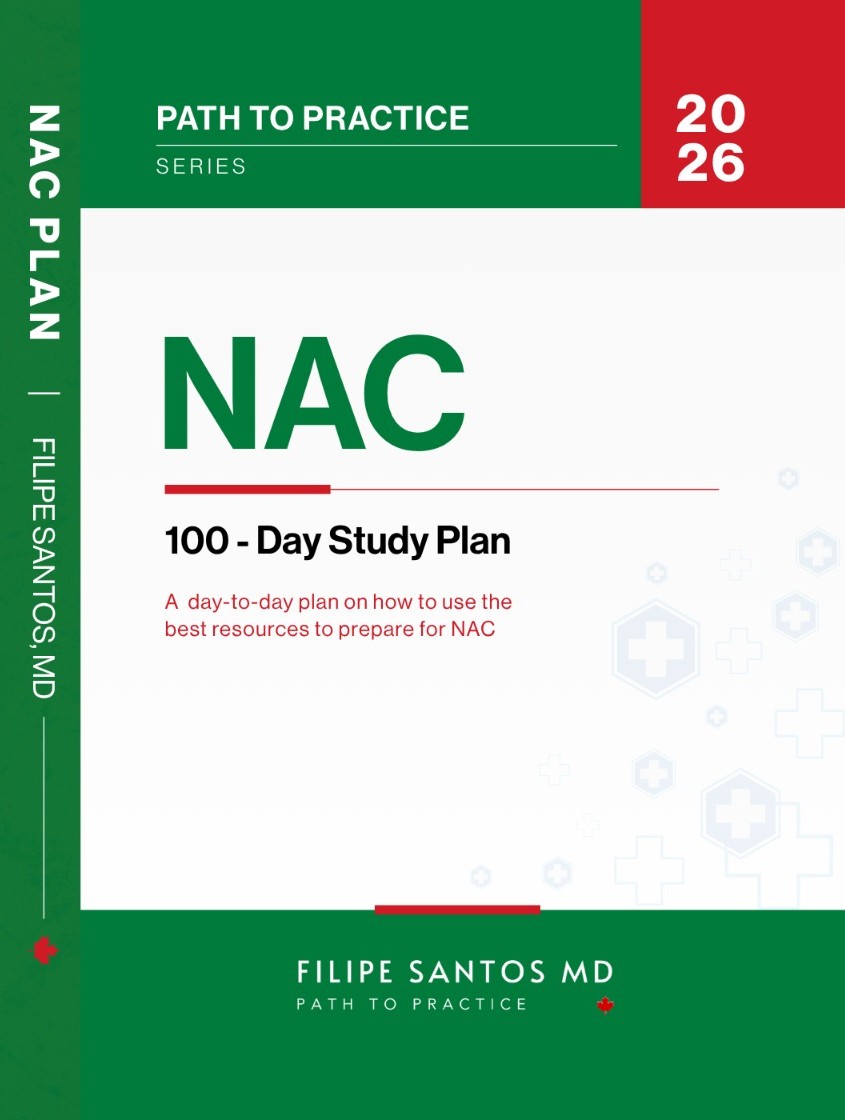
The 100-Day NAC Study Plan
Path to Practice Series, Vol 3
Stop deciding what to study every morning.
Most IMGs preparing for the NAC already have the materials. What they don’t have is a plan. This is 100 days of structured preparation, built on the learning science that actually moves a candidate from knowing medicine to performing it under exam conditions.
♦ 100 daily sessions across 5 phases, with 9 session templates that handle every kind of day
♦ Built on spaced repetition, interleaving, active recall, and tiered topic prioritisation
♦ Pairs with the NAC Strategy Guide, Toronto Notes, the OSCE Handbook, and OSLER AI
$89 CAD | Digital, 7×10 PDF | Instant Access
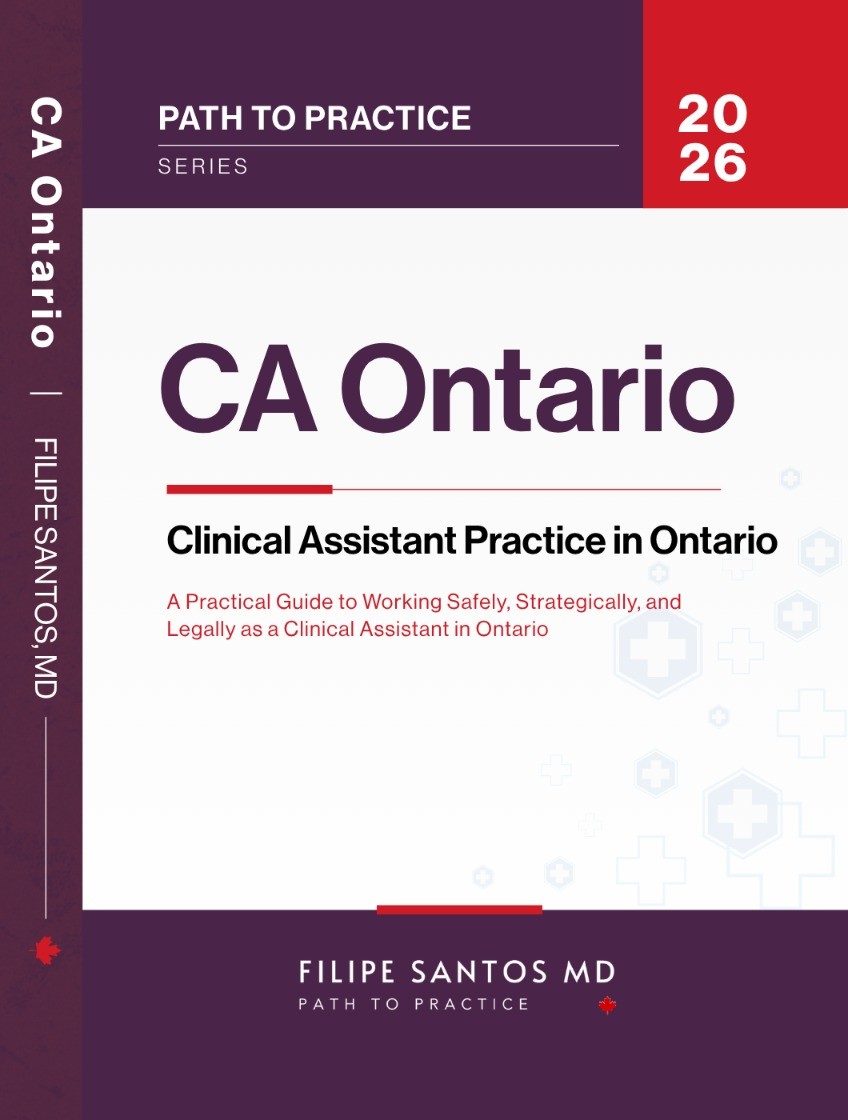
Clinical Assistant Practice in Ontario
The law. The billing. What it means for your career.
Ontario does not register clinical assistants. There is no College, no protected title, no provincial standard. ITPs take CA jobs without ever being told how the role is structured, what is legal for them to do, what their supervising physician can actually bill for, what the contract should say, or how the work counts (or doesn’t) toward licensure. This book is the explanation no one is giving you.
♦ 24 chapters covering RHPA controlled acts, what your supervising physician can bill OHIP for, CPSO delegation policy, PHIPA privacy law, insurance gaps, workplace rights, and contract negotiation
♦ Six case scenarios with worked analysis, including a real PRA recency-of-practice situation many ITPs do not learn about until it is too late
♦ Includes a 2-hour teaching recording on the most consequential topics in the book
$69 CAD | Digital, 200-page PDF + 2h recording | Instant Access
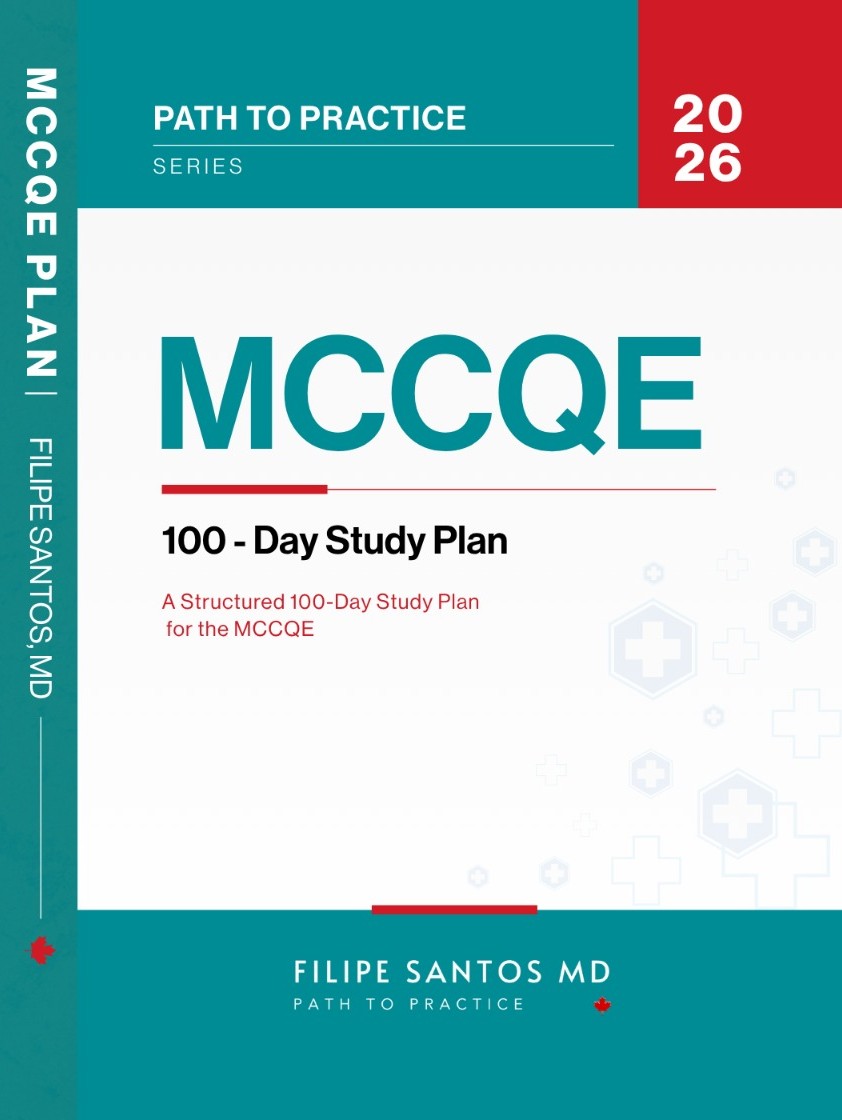
The 100-Day MCCQE Study Plan
Path to Practice Series, Vol 4
Toronto Notes runs over a thousand pages. You have 100 days.
Most candidates do not fail the MCCQE because they did not work hard enough. They fail because the volume of content outpaces any unstructured plan. This book solves the structure problem. 100 daily sessions, priority-weighted, with spaced review built into the calendar.
♦ 61 content days and 39 MCQ days across three phases, with the question load rising as the exam approaches
♦ Built on priority tiering, spaced repetition, active retrieval before reading, and a system that tells you what each kind of wrong answer actually needs
♦ Includes a 2-hour orientation recording on how to run the plan day to day
$89.98 CAD | Digital, PDF + 2h recording | Instant Access
NAC Preparation Bundle
One framework. Three layers. Complete preparation.
Ethics teaches the rules. The NAC Guide teaches the performance. The 100-Day Study Plan runs
the daily schedule. Buying the three together is how the series was designed to be used.
♦ All three guides, instant download
♦ Saves $44.99 vs. buying separately
$199 CAD bundle | Digital | Instant Access
Ethics for MCCQE and NAC
Path to Practice Series, Vol 2
The Canadian rules uou weren’t taught.
Every physician who sits the MCCQE or the NAC already knows medicine. The problem is
different. Canadian medicine operates inside a specific cultural, legal, and institutional
framework that most international training does not include.
The MCC is not asking whether you know patients can refuse treatment. It is asking what
happens next in Canada when they do. Who has authority if the patient loses capacity. What you
must report, to whom, and under which statute. Whether a disclosure is mandatory or
discretionary. These are Canadian rules. If you trained somewhere else, the answers you bring to
the exam may be wrong.
What’s inside
A framework that mirrors how the exam thinks. MCC ethics scenarios fall into three distinct
cognitive demands. Some scenarios ask you to apply a rule. Some ask you to reason through a
tension between two principles. Some ask you to recognize that the rules alone are not enough,
and that the patient’s identity or social position is the clinical data.
The 20 topics in this guide are
organized around those three demands.
Part 1: Apply the Rule. Nine foundational topics: the Four Principles and the CMA Code,
Professionalism, Patient Safety and Disclosure, Consent, Capacity and the SDM Hierarchy,
Confidentiality, Truth-telling, Research Ethics, and the Canadian Healthcare System.
Part 2: Reason Through the Tension. Six high-stakes topics where rules collide: Mandatory
Reporting, End-of-Life and MAID, Conscientious Objection, Reproductive and Adolescent
Ethics, Involuntary Psychiatric Care, and Legal Obligations and Public Safety.
Part 3: Recognize the Context. Five MCC-mandated topics that test whether you see the
structural layer: Indigenous Health, Anti-Oppressive Care, 2SLGBTQQIA+ Health, the Social
Determinants of Health, and Substance Use and Harm Reduction.
“Where Candidates Frequently Go Wrong” in every chapter. Each topic flags the specific
points where international training is most likely to lead you to the wrong Canadian answer, with
the corrected reasoning laid out clearly.
This is for you if;
♦ You’re preparing for the MCCQE Part 1, the NAC, or both
♦ You trained outside Canada and need a single source for Canadian medical ethics
♦ You’ve been piecing ethics together from CMPA advisories, the CMA Code, MCC
objectives, and provincial legislation, and you want it consolidated.
About the author
Dr. Filipe Santos is an anesthesiologist and Assistant Professor at the University of Toronto,
where he teaches medical students and residents. He is the author of the Path to Practice Series.
Format: Digital PDF, 7×10 Access: Instant access after purchase Price: $65 CAD
NAC: A Complete Strategy Guide
Path to Practice Series, Vol 1
The NAC is harder than it looks.
The NAC is a performance exam dressed up as a clinical exam. That single fact is the reason most
IMGs underestimate it. You can know the medicine, walk in confident, and still leak points across
the encounter for reasons that have nothing to do with your clinical knowledge.
A few of those reasons:
♦ Time runs out before the plan is delivered
♦ Reasoning is structured the way it is in the candidate’s home country, not the way Canadian
examiners are scoring
♦ The candidate opens well, then loses points the moment the patient gets upset, confused, or
discloses something hard
♦ The social context is treated as a footnote, when in Canada it is a scoring domain
♦ The candidate knows the diagnosis but cannot present it the way the rating scale is asking for
This guide is built around those gaps. It does not teach medicine. It teaches the specific way a
Canadian OSCE has to be performed and scored, and it gives you a framework for every
component of an encounter so nothing is left to chance on the day.
What’s inside;
The 4-Step History Framework. Define, Explore, Zoom Out, Check In. A repeatable structure for
taking a focused, scorable history under time pressure, with specialty variants for psychiatry,
obstetrics, and pediatrics.
The Narration Framework for physical examination. What to say out loud, when to say it, and
how to translate every manoeuvre into the language examiners are listening for. Includes
worked narration examples for the major systems.
SPIKES and PEARLS for communication stations. The two communication frameworks
Canadian examiners expect you to know, plus a library of sample phrases for every stage of an
encounter, including the difficult conversations that decide pass or fail.
The IDEA structure for diagnosis and management. Impression, Differential, Evidence, Action.
How to present clinical reasoning in a way that earns marks across the differential, the
investigations, and the management plan, even when you are uncertain.
Station archetypes, decoded. A breakdown of the major NAC station types, including the “How
to recognize this station” cues that tell you, in real time, what is actually being tested.
The 7 failure patterns. A direct analysis of the most common habits that quietly cost
knowledgeable IMGs their pass, with the specific corrections for each.
The scoring lens, explained. How examiners weight the three core domains and the seven
competencies, and where international candidates predictably leak points.
A curated video library. A hand-reviewed library of free videos for every major NAC topic,
organized first by discipline (PHELO, Psychiatry, Internal Medicine, Surgery, Obstetrics and
Gynecology, Pediatrics) and then by skill (history taking, communication, physical examination,
investigations). Every entry is a direct link to a free resource on YouTube or an academic site
(Boston University, Stanford, and others), so you can move from a topic to a video without
searching for it.
A reviewed list of NAC study resources. Honest reviews of Toronto Notes, the Edmonton
Manual, the OSCE Handbook, OSLER AI, and Master The NAC, with guidance on what each is
and is not good for.
This is for you if
♦ You are preparing for the NAC OSCE and want a written strategy guide, not a video course
♦ You trained outside Canada and need to bridge the gap to Canadian clinical expectations
♦ You want one reference that covers structure, scoring, frameworks, and resources in one place.
Best paired with
The 100-Day NAC Study Plan (the day-by-day execution plan built around this guide), Toronto
Notes, the Edmonton Manual, the OSCE Handbook, OSLER AI for scenario practice, and any
clinical reference you already use. The Strategy Guide is the framework layer. Your clinical
references are the content layer. Used together, the two cover everything the NAC tests.
About the author
Dr. Filipe Santos is an anesthesiologist and Assistant Professor at the University of Toronto,
where he teaches medical students and residents. He is the author of the Path to Practice Series.
Format: Digital PDF, 7×10 Access: Instant access after purchase
Price: $89.99 CAD
The 100-Day NAC Study Plan
Path to Practice Series, Vol 3
Stop deciding what to study every morning.
Most IMGs preparing for the NAC are not short on materials. They have Toronto Notes. They
have OSLER AI. They may have the OSCE Handbook and the Edmonton Manual on the shelf.
What they don’t have is a plan, and so every morning starts with the same question and the same
lost time: what am I doing today?
This is the answer. 100 daily sessions, structured into 5 phases, with the priorities and the
rotation already decided for you. You open the page, you do the work, you close the day.
The decisions are already made.
Built on the learning science that actually works
The plan is not a list of topics laid out in order. It is a deliberate application of the learning
techniques that decades of cognitive research have shown to outperform passive review:
♦ Spaced repetition. Topics return at calibrated intervals, not on the days they were first
studied, so material is encoded into long-term memory rather than crammed.
♦ Interleaving. Disciplines and station types are mixed across the rotation rather than
blocked together, which is how the exam itself presents material and how the brain best
learns to discriminate between similar problems.
♦ Active recall. Every standard day opens with a brain dump, where you reconstruct what
you remember from memory before opening any reference. This is the single most
evidence-based study technique in cognitive science.
♦ Tiered prioritisation. Every topic in the plan is tagged by tier so the highest-yield material
gets the most repetitions across the 100 days. The mixing is built into the schedule itself, so
you don’t have to design it.
♦ Reflection. Every day closes with prompts that surface recurring weak spots and feed
directly into the next spaced review
What’s inside
100 daily session cards. Each day specifies the template, the discipline, the topic, the tier, and
the resources to use. No daily decisions. Open the page and execute.
5 phases with deliberate pacing. Foundations, Momentum, Pivot, Integration, and Command.
Each phase has a different purpose, and the workload is calibrated so you arrive at the exam
having peaked, not burned out.
9 session templates that handle every type of day. T1 for most clinical content. T2 for psychiatry
with the MSE. T4 for physical examination. T5 for behavioural counselling. T6 for breaking bad
news. T7 for mock exam. T8 for spaced review. The structure is decided once and reused.
The OPENER framework. The six-step encounter structure used in almost every station, with
deliberate cues for which letter matters most for that station type. Practice blocks throughout the
plan are built around it.
The REVISE framework for spaced review. A six-step recall structure used on every spaced
review day, designed to surface where your understanding actually breaks down, not just where
it feels shaky.
A built-in mock exam progression. Six full mock exams structured into Phase 5 (Command),
with reflection windows around each one so you turn each mock into a diagnostic, not just a
stress test.
This is for you if
♦ You are preparing for the NAC and want the structure handled for you
♦ You learn better against a deadline and a daily session than from open-ended study
♦ You are willing to use evidence-based techniques even when they feel less comfortable
than re-reading
How to use it
The plan is 100 days, paced however you decide. Most candidates run it as 100 consecutive days.
Some take a recovery day each week. Some stretch it across longer windows. The plan does not
stipulate when you study, only what to study and how the day is structured.
Best paired with
The NAC Strategy Guide (referenced on most content days for the frameworks), Toronto Notes,
the OSCE Handbook, the Edmonton Manual, and Bates’ Guide to Physical Examination on
selected days. OSLER AI is optional but highly recommended for the practice blocks. The plan
tells you when to use each resource.
About the author
Dr. Filipe Santos is an anesthesiologist and Assistant Professor at the University of Toronto,
where he teaches medical students and residents. He is the author of the Path to Practice Series.
Format: Digital PDF, 7×10 Access: Instant access after purchase Price: $89 CAD
The Path to Practice Bundle
One framework. Three layers. Complete preparation.
Most IMGs preparing for the MCCQE or the NAC are juggling three problems at once. They do
not know the Canadian ethical framework. They have not been taught how to perform inside a
Canadian OSCE. And they do not have a daily schedule to put their preparation on. Each guide in
the Path to Practice Series solves one of those problems.
How the three guides work together
Ethics for MCCQE and NAC. The rules layer. The Canadian ethical and legal framework, with
explicit callouts for where international training conflicts with Canadian standards. Used for
MCCQE Part 1 ethics questions and NAC ethics stations.
NAC: A Complete Strategy Guide. The performance layer. Frameworks for history taking,
physical examination narration, communication, and clinical reasoning. The reference text
behind every encounter.
The 100-Day NAC Study Plan. The execution layer. The day-by-day plan that decides what to
study, when to practise, and how to revise. Built on the NAC Guide’s frameworks.
Why bundle
The 100-Day Study Plan references the NAC Guide on most content days. The NAC Guide
assumes the ethics topics are covered separately. The three guides were built to be used together,
and the bundle reflects that.
What you get
All three digital PDFs, delivered instantly after purchase. Same digital files, same instant access.
$199 CAD total, which saves you $44.99 off the individual prices.
Clinical Assistant Practice in Ontario
Clinical Assistant Practice in Ontario, Path to Practice Series, Vol 5
The law. The billing. What it means for your career.
Eight provinces in Canada license clinical assistants directly. Ontario does not. There is no provincial College, no protected title, no published salary scale, and no body that audits how the role is structured before you sign a contract. The role exists by private contract between you and the hiring physician, operating inside the limits of the Regulated Health Professions Act, the OHIP Schedule of Benefits, and CPSO policy on delegation.
Most ITPs working as clinical assistants in Ontario do not have a clear picture of any of that. They are told what their hours and pay will be, then asked to figure out the rest as they go. The legal frame, the billing rules that govern what their supervising physician can bill for, the documentation expectations, the insurance gap, the CV implications, the PRA hours problem: these are surfaced only when something goes wrong, or when a licence application reveals that the work did not count the way the candidate assumed it would.
This book exists so you do not learn any of that the hard way.
What’s inside
Part One. Foundations (Chapters 1–6). The two frameworks that govern your work, the locked terminology, how licensing differs from regulation, Ontario’s 27 regulated professions, how other provinces structure CA work, and the federal picture. Reach for this when the system itself feels opaque.
Part Two. The Rules in Detail (Chapters 7–10). The 14 RHPA controlled acts and what counts as a public-domain activity, what your supervising physician can personally bill OHIP for and the narrow list of delegated procedures they can bill when you perform them, the seven CPSO delegation requirements, the May 2026 CPSO Guidance (including the specific clarifications about foreign credentials and title use that affect ITPs), the misread “monetary gain and convenience” rule, and the title rule.
Part Three. Working in the Role (Chapters 11–15). The supervising physician relationship and the language patterns that make delegation visible in the chart, the CMPA insurance gap unique to Ontario CAs and how to think about it, PHIPA privacy law and the five failures CAs typically get caught on (including the two enforcement routes that can reach you personally), the patient introduction script that protects you, and the workplace statutes that set your floor (ESA, OHSA, Human Rights Code).
Part Four. Career Strategy (Chapters 16–21). The five screens for any job offer, the T4-vs-T4A decision that determines whether you have ESA protection, the logbook that turns private contract work into a credible track record, how to present CA work on a CV, how to structure reference letters for CaRMS, and how to build your application profile beyond the CA role.
Part Five. Synthesis and Reference (Chapters 22–24). How the rules are enforced, six case scenarios with worked analysis (three drawn from CPSO Dialogue and three from my own practice and consulting work, including the PRA recency-of-practice situation that catches ITPs who assume their CA hours will count toward licensure), and a final chapter on using the role strategically. Plus a Quick Reference section.
The 2-hour teaching recording
Included with the book. A live session covering the most consequential topics: what the role actually is in Ontario law, what is legal for you to do versus what your supervising physician can bill for, how delegation must be documented to satisfy CPSO policy, what to look for before signing a contract, how PHIPA reaches you personally, and what CA work can and cannot do for your career. This is teaching, not a book walkthrough. The book is the reference. The recording is the orientation.
This is for you if
♦ You are an ITP currently working as a clinical assistant in Ontario, or considering an offer
♦ You are unclear whether something you have been asked to do is legal, whether your supervising physician can actually bill for it, or whether it is properly delegated
♦ You want to know what to negotiate, what to document, and how the work will be read by future regulators and program directors
♦ You are running CA work in parallel with MCCQE, NAC OSCE, or PRA timelines and want to know exactly how each fits
About the author
Dr. Filipe Santos is an anesthesiologist and Assistant Professor at the University of Toronto, where he teaches medical students and residents. He is the author of the Path to Practice Series.
Format: Digital PDF (200 pages) + 2-hour teaching recording Access: Instant access after purchase Price: $69 CAD
The 100-Day MCCQE Study Plan
Path to Practice Series, Vol 4
Toronto Notes runs over a thousand pages. You have 100 days.
The MCCQE is a structural problem before it is a knowledge problem. Toronto Notes alone runs over a thousand pages. The exam pulls from six disciplines: Internal Medicine, Surgery, Pediatrics, Obstetrics and Gynecology, Psychiatry, and PHELO (Public Health, Ethics, Law, and Organization). Most candidates are working, supporting families, and trying to translate clinical experience from another system into the language of Canadian practice. The exam adjusts for none of that.
Candidates who pass the MCCQE do not necessarily study more. They study better. They know what to read on each day, in what order, and what to leave alone. They build retrieval into their schedule. They review at the right intervals. They sit timed practice blocks and walk away with a diagnosis of their own learning, not just a score.
This book is that structure in working form. 100 daily sessions, every topic named, every review scheduled, every page of Toronto Notes 2025 mapped to the day you should read it.
What the plan is built on
Priority tiering. Every topic in Toronto Notes 2025 is tagged Very High, High, Medium, or Low. Very High topics receive one initial study plus two spaced reviews. High topics get one initial plus one review. Medium topics get a single focused study. Low topics are excluded from the calendar and live in the appendix as reference. The exam concentrates on what the priority schema tells you to concentrate on.
Spaced review. Reviews are not casual filler. They are placed in the calendar at intervals that respect how human memory actually works. Move the reviews and the plan stops working.
Active retrieval before reading. Every content day opens with a Brain Dump where you reconstruct what you remember about each topic across five dimensions (features, etiology, clinical workup, treatment, and safety) before opening any reference. Retrieval strengthens memory. Rereading creates fluency, not recall, and the exam rewards recall.
A three-phase architecture. The plan changes personality as the exam approaches. Phase 1 (Foundations, Days 1–50) is content-heavy, building the spine. Phase 2 (Consolidation, Days 51–75) is balanced and tests whether your learning is sticking. Phase 3 (Command, Days 76–100) flips to 64% MCQ days, so you finish the way you will sit the exam: under time pressure, calibrating pace.
Reflection that compounds. Every day closes with three prompts that surface what was hardest to retain, what is most likely to appear on the exam, and what your Brain Dump missed. Reflection feeds your next review session a target list, not a vague feeling.
What’s inside
100 daily session cards. Each card names the discipline, the topics in priority order, and the resources to use. The card is the day. No daily decisions.
A wrong-answer analysis system. Every wrong MCQ gets tagged as one of four error types: a content gap (you did not know it), a question misread (you missed a keyword), wrong reasoning (you applied your knowledge incorrectly), or time pressure (you would have got it with more time). Each error type requires a different response. Most candidates answer every wrong question with “do more questions,” which only fixes one of the four. This system gives you the right response for each.
Direct integration with Ethics for MCCQE and NAC. Every PHELO day in the plan pulls specific chapters from the Ethics Book on a published schedule. Ethics is woven through the 100 days from Day 11 onward, not crammed into the last two weeks.
Topics Beyond Plan appendix. Low-priority topics that did not earn a scheduled slot. Reference, not homework. Use it only if you finish a discipline early or if your wrong-answer log keeps pointing at one specific weakness.
The 2-hour orientation recording
Included with the book. A complete walkthrough of how to run the plan: what the MCCQE actually rewards, why the architecture is built the way it is, how to run a Content day and an MCQ day, how to navigate the book, and how to recover when life disrupts the schedule. Most candidates buy study resources and use them incorrectly. The recording is the difference between owning the book and operating it.
This is for you if
- You are preparing for the MCCQE and want a daily plan, not a list of topics
- You already have, or are willing to buy, Toronto Notes 2025 and a primary QBank
- You learn better against a structured plan than from open-ended study
How to use it
The plan is 100 days, paced however you decide. Most candidates run it as 100 consecutive days. Some take a recovery day each week. The plan does not stipulate when you study, only what to study, in what order, and how the day is structured.
Best paired with
Toronto Notes 2025 (the primary reference, mapped page-by-page throughout the plan), Ethics for MCCQE and NAC (woven into PHELO days from Day 11), and a single primary QBank (UWorld, Canada QBank, or the MCC official products). The plan tells you when to use each one.
About the author
Dr. Filipe Santos is an anesthesiologist and Assistant Professor at the University of Toronto, where he teaches medical students and residents. He is the author of the Path to Practice Series.
Format: Digital PDF + 2-hour orientation recording Access: Instant access after purchase Price: $89.98 CAD