Clinical Assistant Practice in Ontario
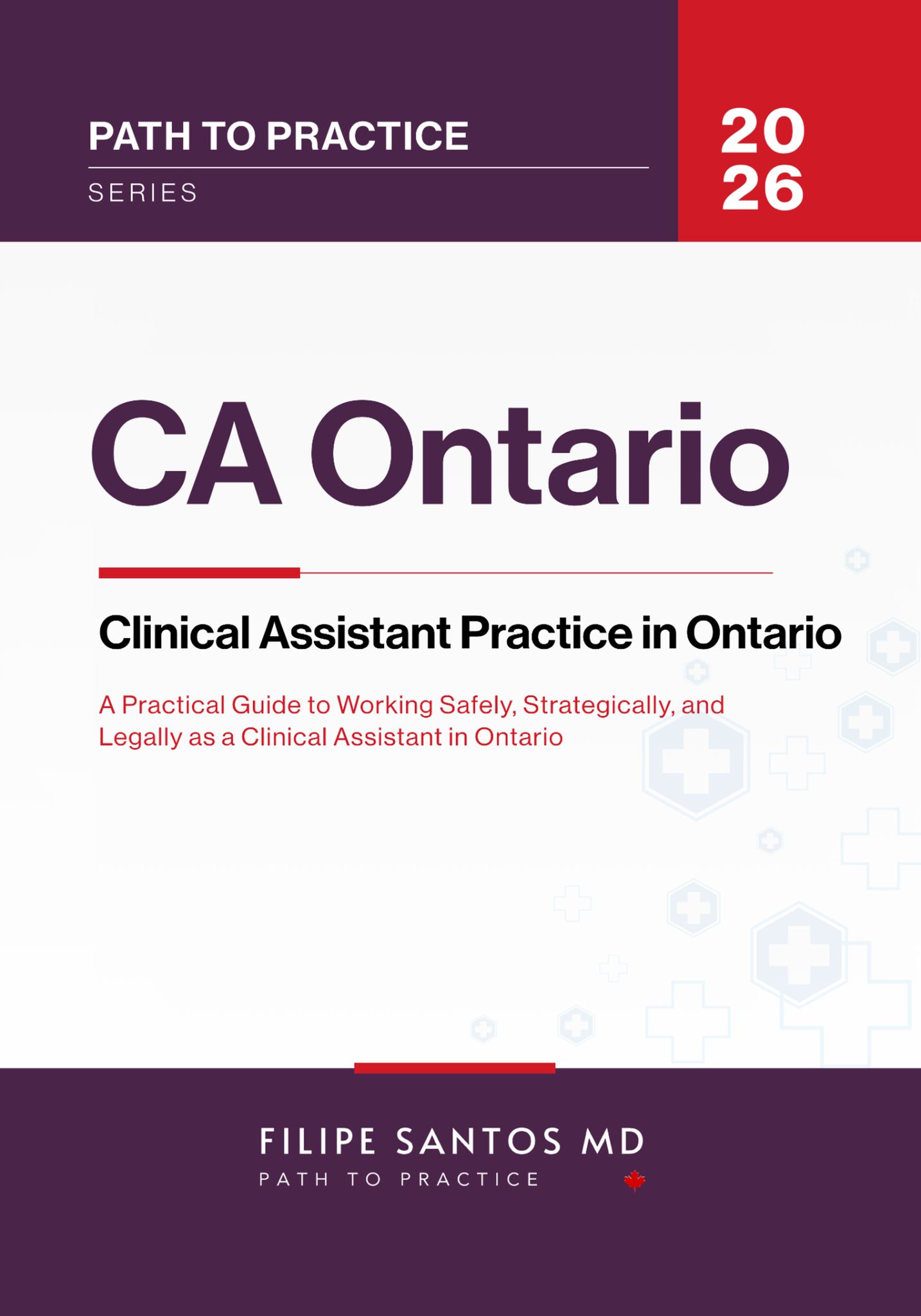
Clinical Assistant Practice in Ontario, Path to Practice Series, Vol 5
The law. The billing. What it means for your career.
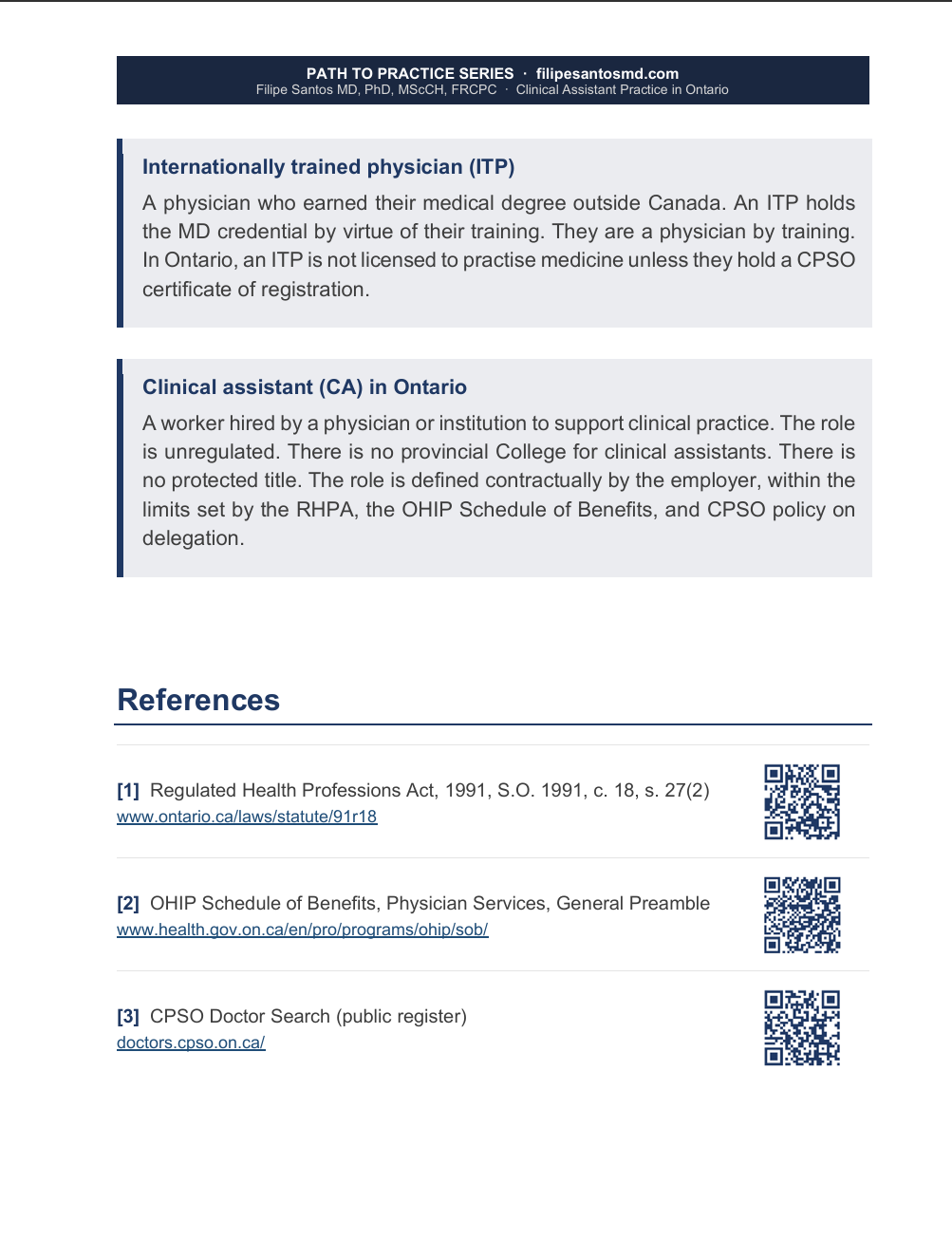
Eight provinces in Canada license clinical assistants directly. Ontario does not. There is no provincial College, no protected title, no published salary scale, and no body that audits how the role is structured before you sign a contract. The role exists by private contract between you and the hiring physician, operating inside the limits of the Regulated Health Professions Act, the OHIP Schedule of Benefits, and CPSO policy on delegation.
Most ITPs working as clinical assistants in Ontario do not have a clear picture of any of that. They are told what their hours and pay will be, then asked to figure out the rest as they go. The legal frame, the billing rules that govern what their supervising physician can bill for, the documentation expectations, the insurance gap, the CV implications, the PRA hours problem: these are surfaced only when something goes wrong, or when a licence application reveals that the work did not count the way the candidate assumed it would.
This book exists so you do not learn any of that the hard way.
What’s inside
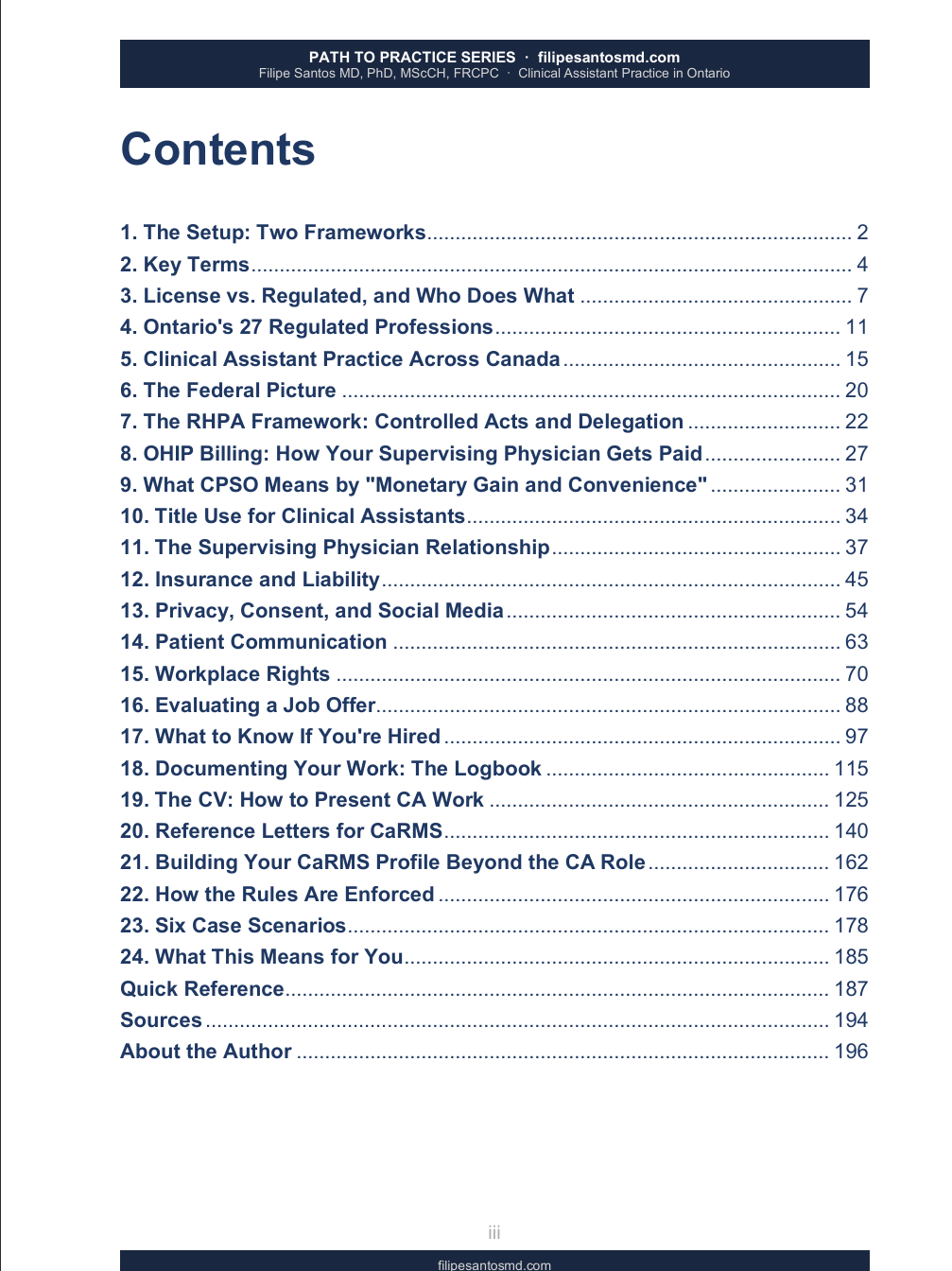
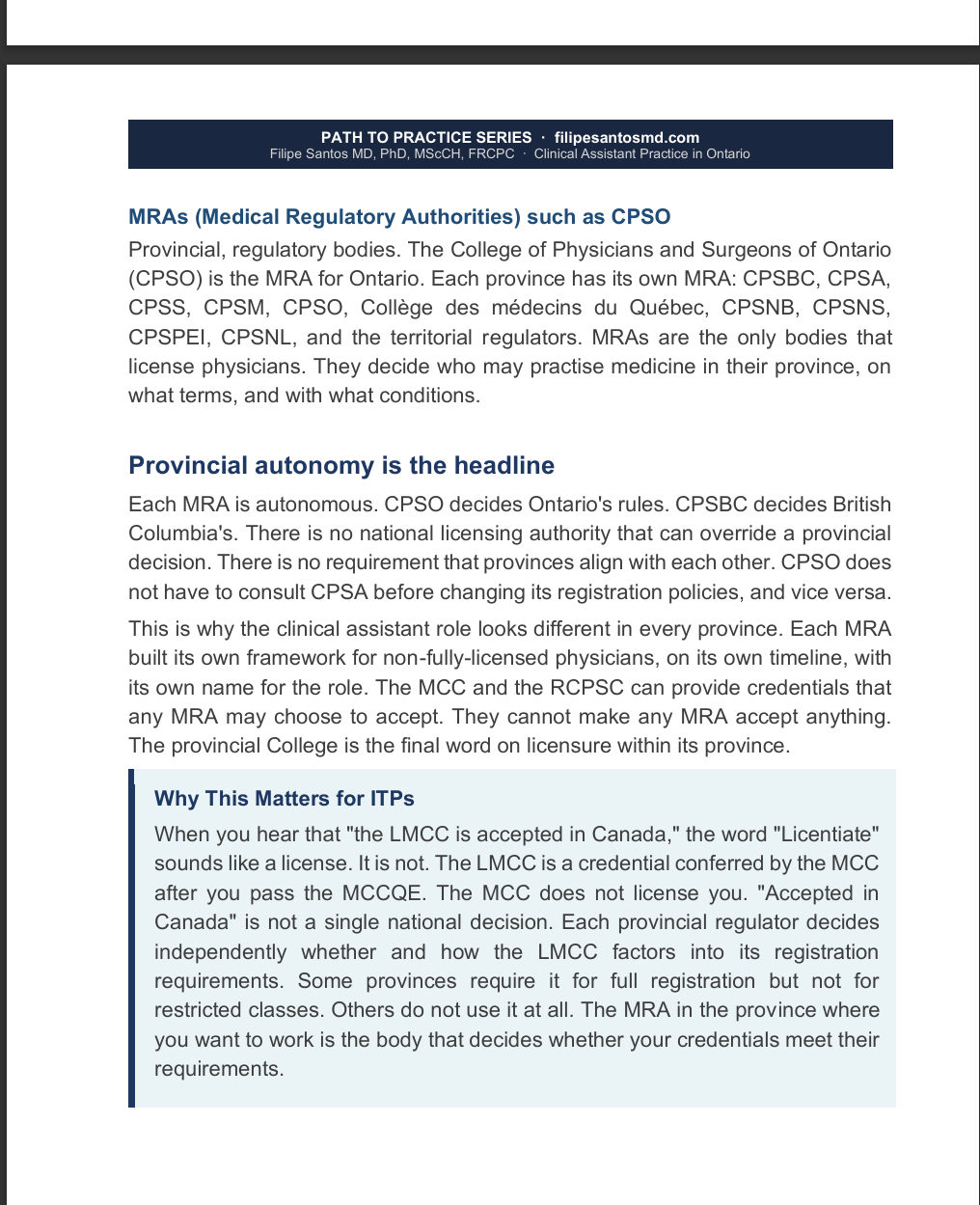
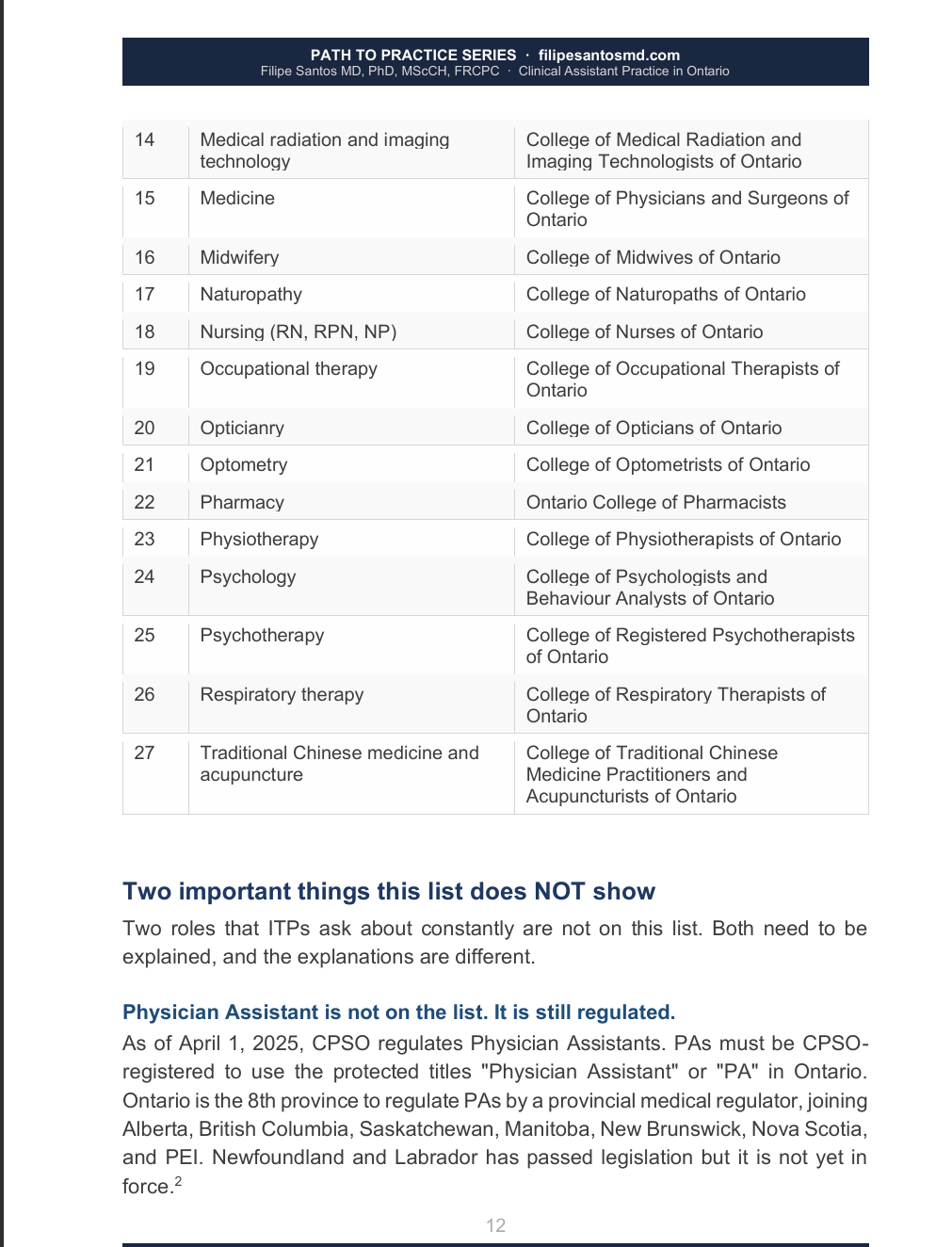
Part One. Foundations (Chapters 1–6). The two frameworks that govern your work, the locked terminology, how licensing differs from regulation, Ontario’s 27 regulated professions, how other provinces structure CA work, and the federal picture. Reach for this when the system itself feels opaque.
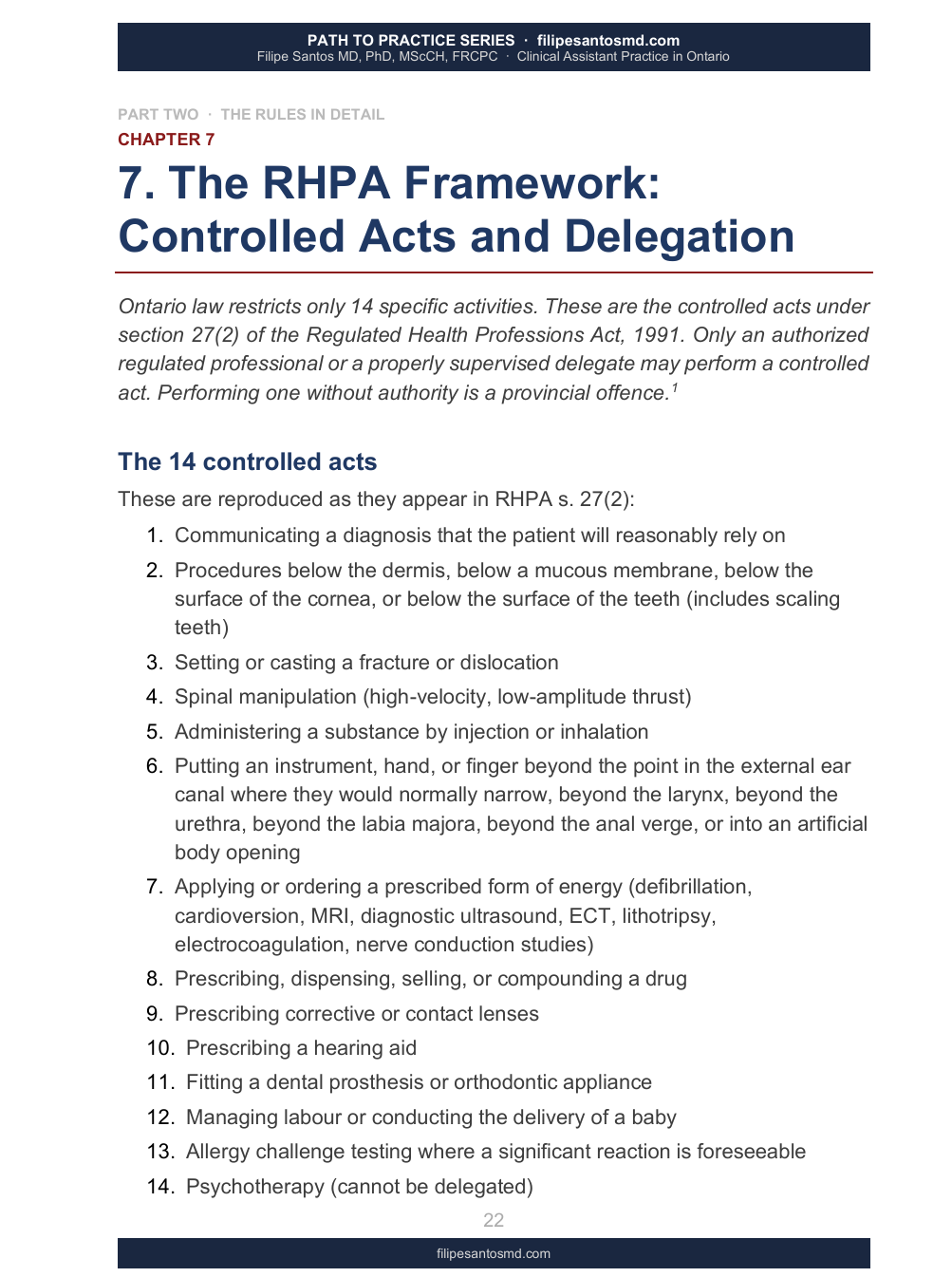
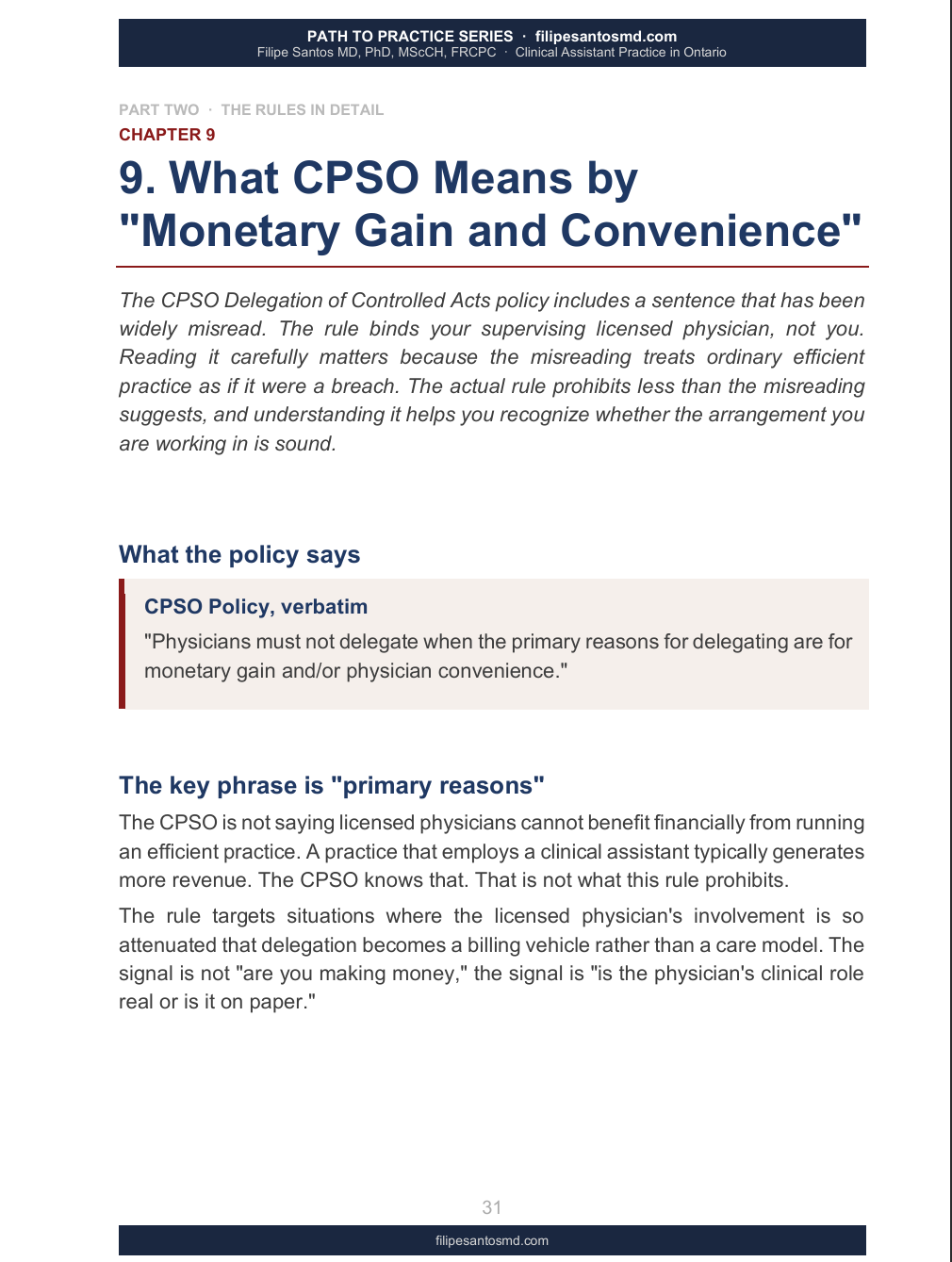
Part Two. The Rules in Detail (Chapters 7–10). The 14 RHPA controlled acts and what counts as a public-domain activity, what your supervising physician can personally bill OHIP for and the narrow list of delegated procedures they can bill when you perform them, the seven CPSO delegation requirements, the May 2026 CPSO Guidance (including the specific clarifications about foreign credentials and title use that affect ITPs), the misread “monetary gain and convenience” rule, and the title rule.
Part Three. Working in the Role (Chapters 11–15). The supervising physician relationship and the language patterns that make delegation visible in the chart, the CMPA insurance gap unique to Ontario CAs and how to think about it, PHIPA privacy law and the five failures CAs typically get caught on (including the two enforcement routes that can reach you personally), the patient introduction script that protects you, and the workplace statutes that set your floor (ESA, OHSA, Human Rights Code).
Part Four. Career Strategy (Chapters 16–21). The five screens for any job offer, the T4-vs-T4A decision that determines whether you have ESA protection, the logbook that turns private contract work into a credible track record, how to present CA work on a CV, how to structure reference letters for CaRMS, and how to build your application profile beyond the CA role.
Part Five. Synthesis and Reference (Chapters 22–24). How the rules are enforced, six case scenarios with worked analysis (three drawn from CPSO Dialogue and three from my own practice and consulting work, including the PRA recency-of-practice situation that catches ITPs who assume their CA hours will count toward licensure), and a final chapter on using the role strategically. Plus a Quick Reference section.
The 2-hour teaching recording
Included with the book. A live session covering the most consequential topics: what the role actually is in Ontario law, what is legal for you to do versus what your supervising physician can bill for, how delegation must be documented to satisfy CPSO policy, what to look for before signing a contract, how PHIPA reaches you personally, and what CA work can and cannot do for your career. This is teaching, not a book walkthrough. The book is the reference. The recording is the orientation.
This is for you if
♦ You are an ITP currently working as a clinical assistant in Ontario, or considering an offer
♦ You are unclear whether something you have been asked to do is legal, whether your supervising physician can actually bill for it, or whether it is properly delegated
♦ You want to know what to negotiate, what to document, and how the work will be read by future regulators and program directors
♦ You are running CA work in parallel with MCCQE, NAC OSCE, or PRA timelines and want to know exactly how each fits
About the author
Dr. Filipe Santos is an anesthesiologist and Assistant Professor at the University of Toronto, where he teaches medical students and residents. He is the author of the Path to Practice Series.
Format: Digital PDF (200 pages) + 2-hour teaching recording Access: Instant access after purchase | No physical shipment.
Price: $69 CAD
Look Inside