The 100-Day MCCQE Study Plan
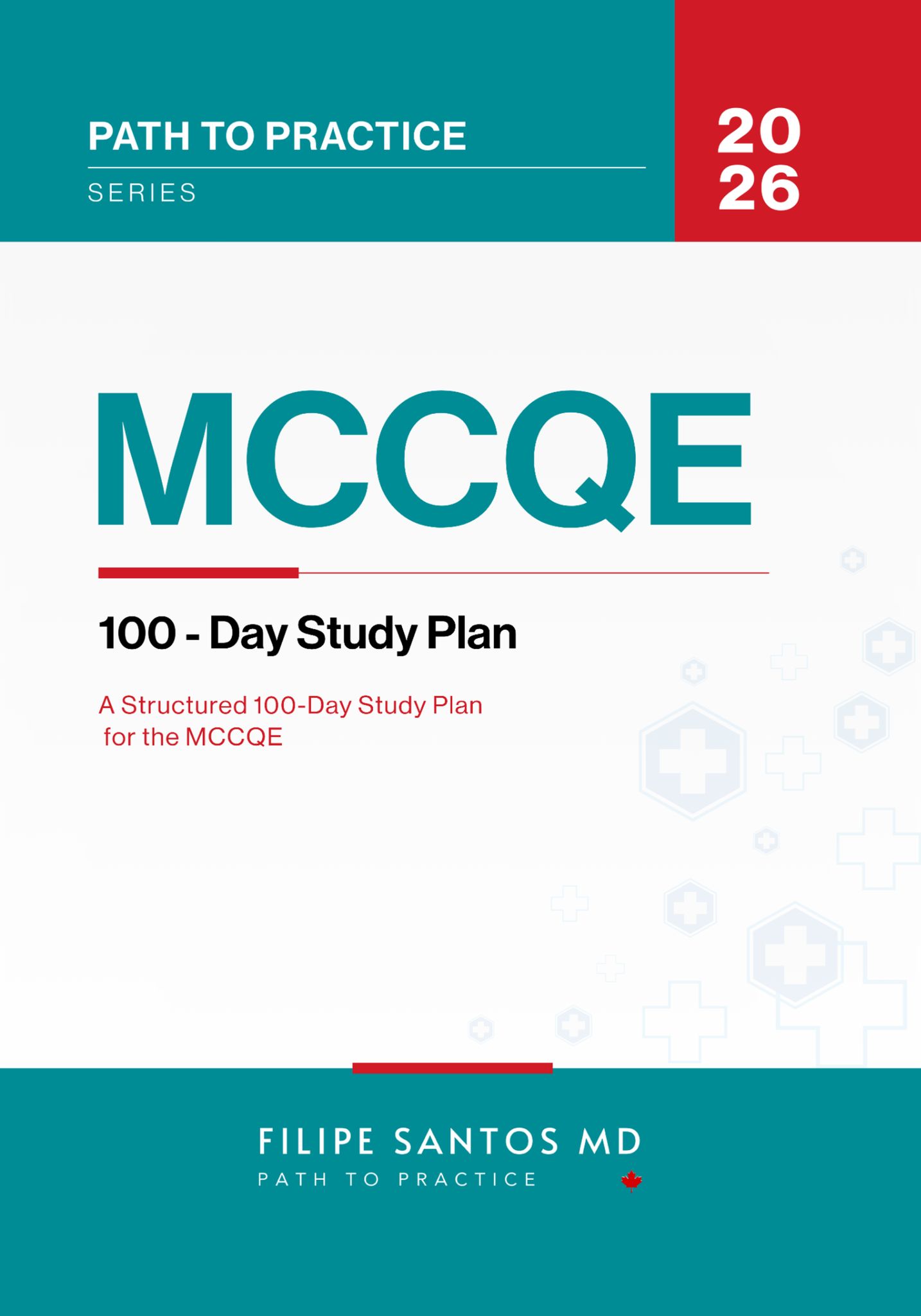
Path to Practice Series, Vol 4
Toronto Notes runs over a thousand pages. You have 100 days.
The MCCQE is a structural problem before it is a knowledge problem. Toronto Notes alone runs over a thousand pages. The exam pulls from six disciplines: Internal Medicine, Surgery, Pediatrics, Obstetrics and Gynecology, Psychiatry, and PHELO (Public Health, Ethics, Law, and Organization). Most candidates are working, supporting families, and trying to translate clinical experience from another system into the language of Canadian practice. The exam adjusts for none of that.
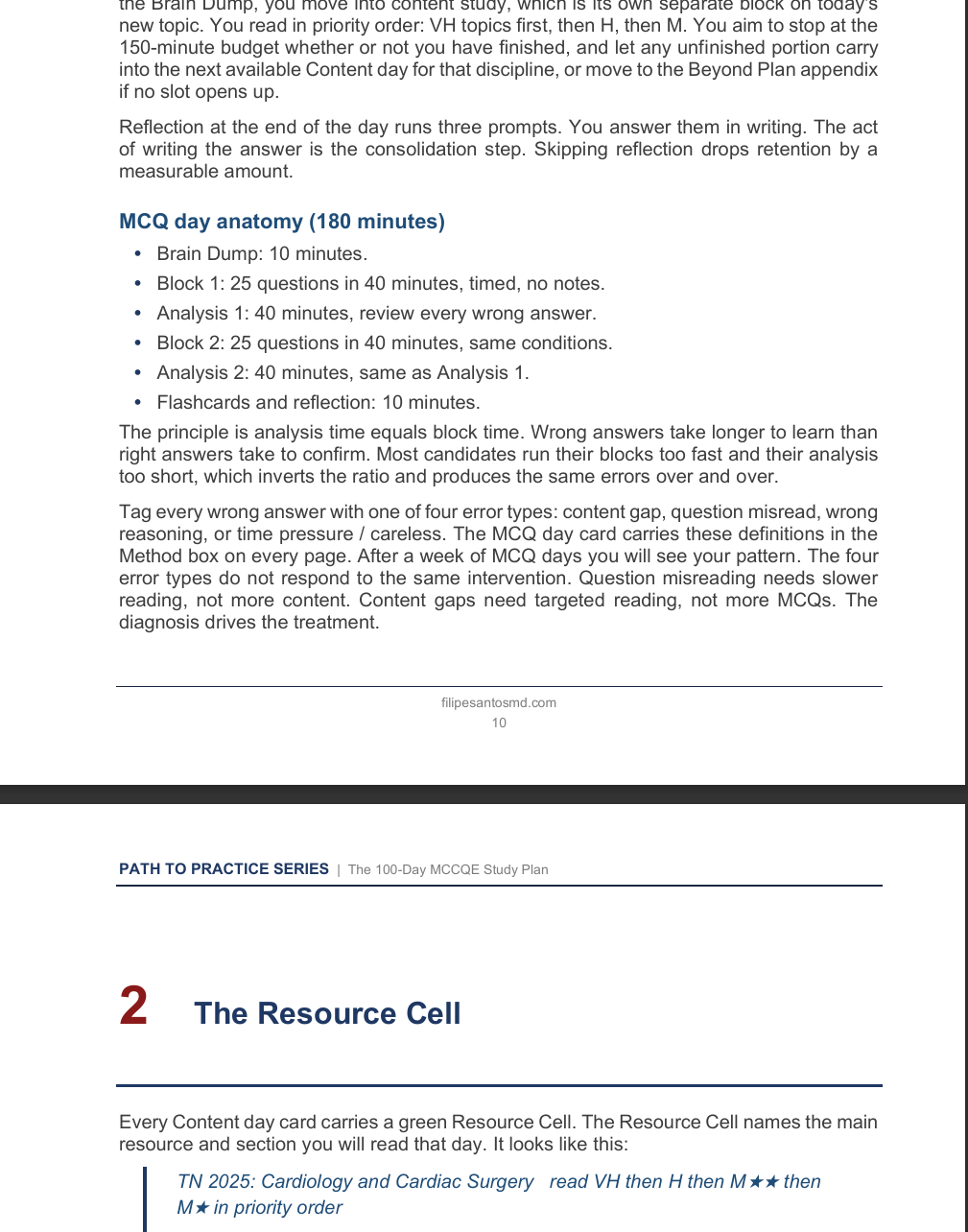
Candidates who pass the MCCQE do not necessarily study more. They study better. They know what to read on each day, in what order, and what to leave alone. They build retrieval into their schedule. They review at the right intervals. They sit timed practice blocks and walk away with a diagnosis of their own learning, not just a score.
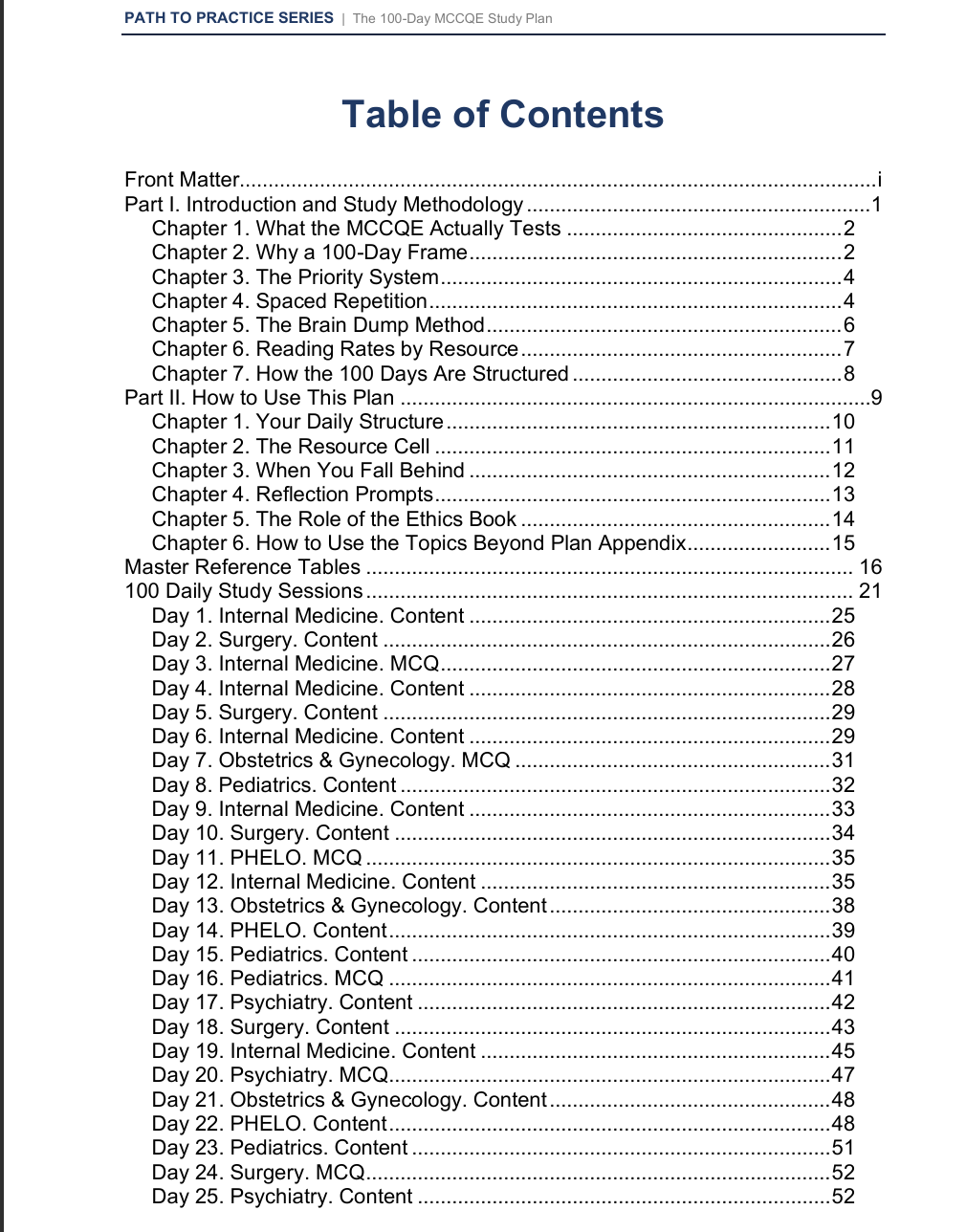
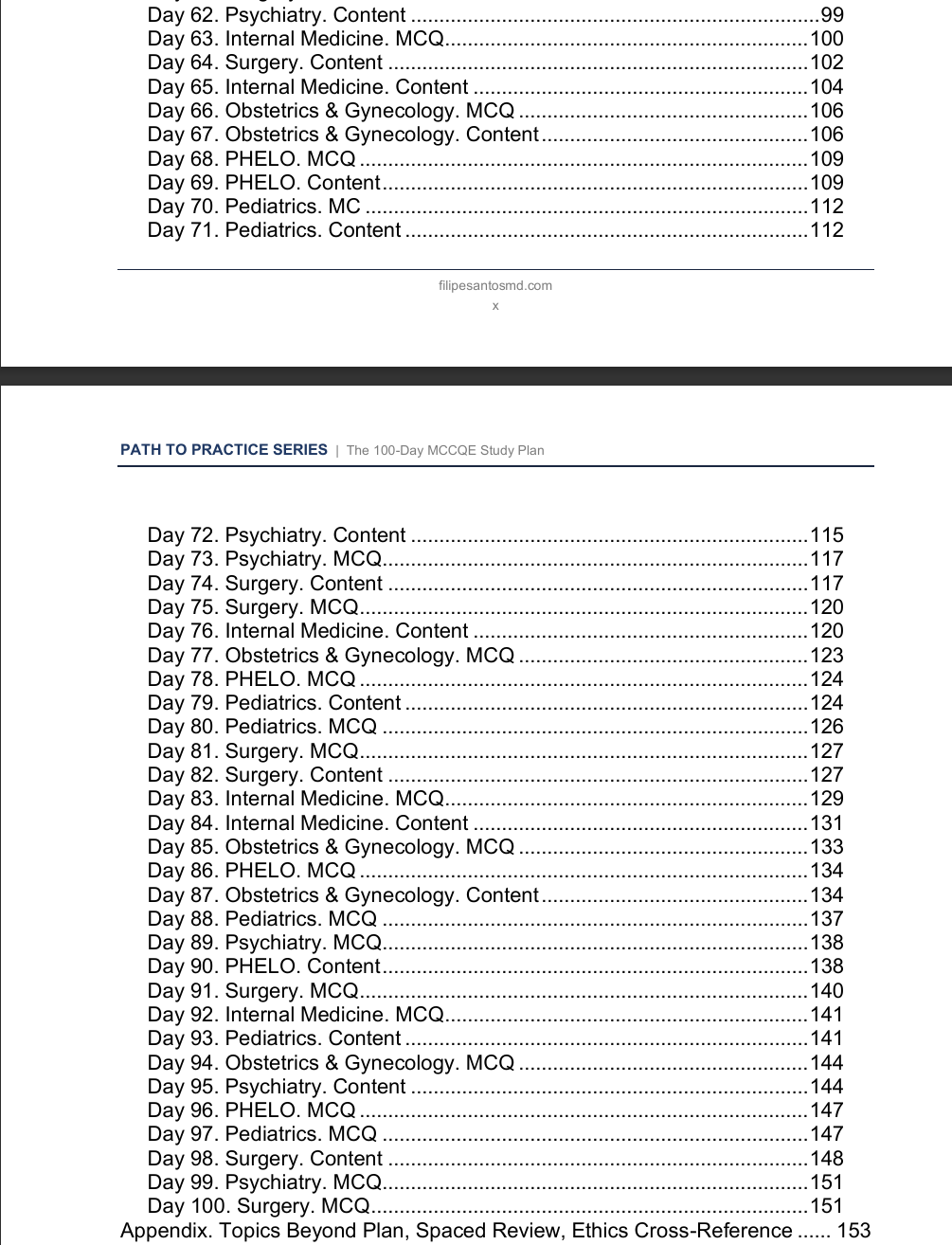
This book is that structure in working form. 100 daily sessions, every topic named, every review scheduled, every page of Toronto Notes 2025 mapped to the day you should read it.
What the plan is built on
Priority tiering. Every topic in Toronto Notes 2025 is tagged Very High, High, Medium, or Low. Very High topics receive one initial study plus two spaced reviews. High topics get one initial plus one review. Medium topics get a single focused study. Low topics are excluded from the calendar and live in the appendix as reference. The exam concentrates on what the priority schema tells you to concentrate on.
Spaced review. Reviews are not casual filler. They are placed in the calendar at intervals that respect how human memory actually works. Move the reviews and the plan stops working.
Active retrieval before reading. Every content day opens with a Brain Dump where you reconstruct what you remember about each topic across five dimensions (features, etiology, clinical workup, treatment, and safety) before opening any reference. Retrieval strengthens memory. Rereading creates fluency, not recall, and the exam rewards recall.
A three-phase architecture. The plan changes personality as the exam approaches. Phase 1 (Foundations, Days 1–50) is content-heavy, building the spine. Phase 2 (Consolidation, Days 51–75) is balanced and tests whether your learning is sticking. Phase 3 (Command, Days 76–100) flips to 64% MCQ days, so you finish the way you will sit the exam: under time pressure, calibrating pace.
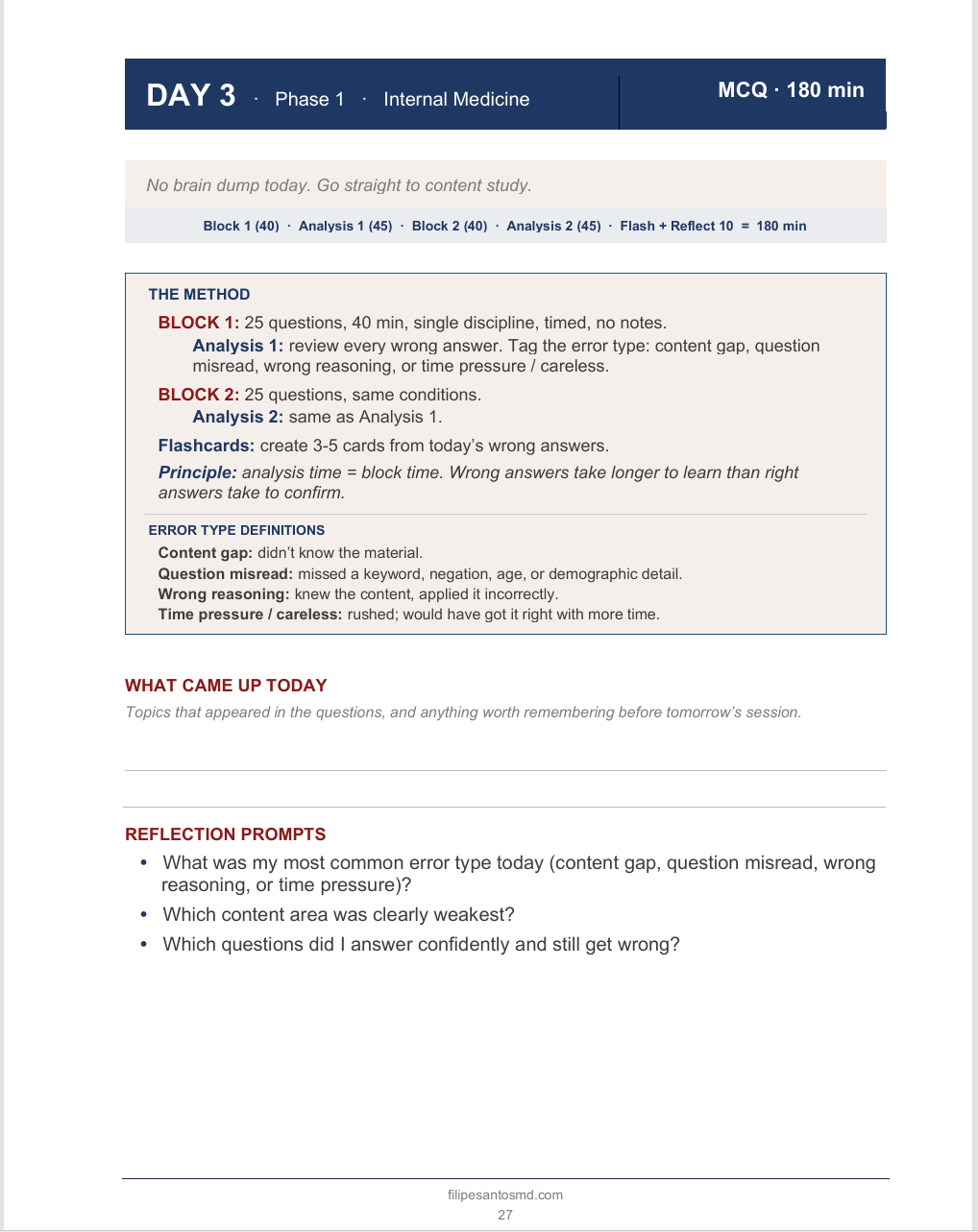
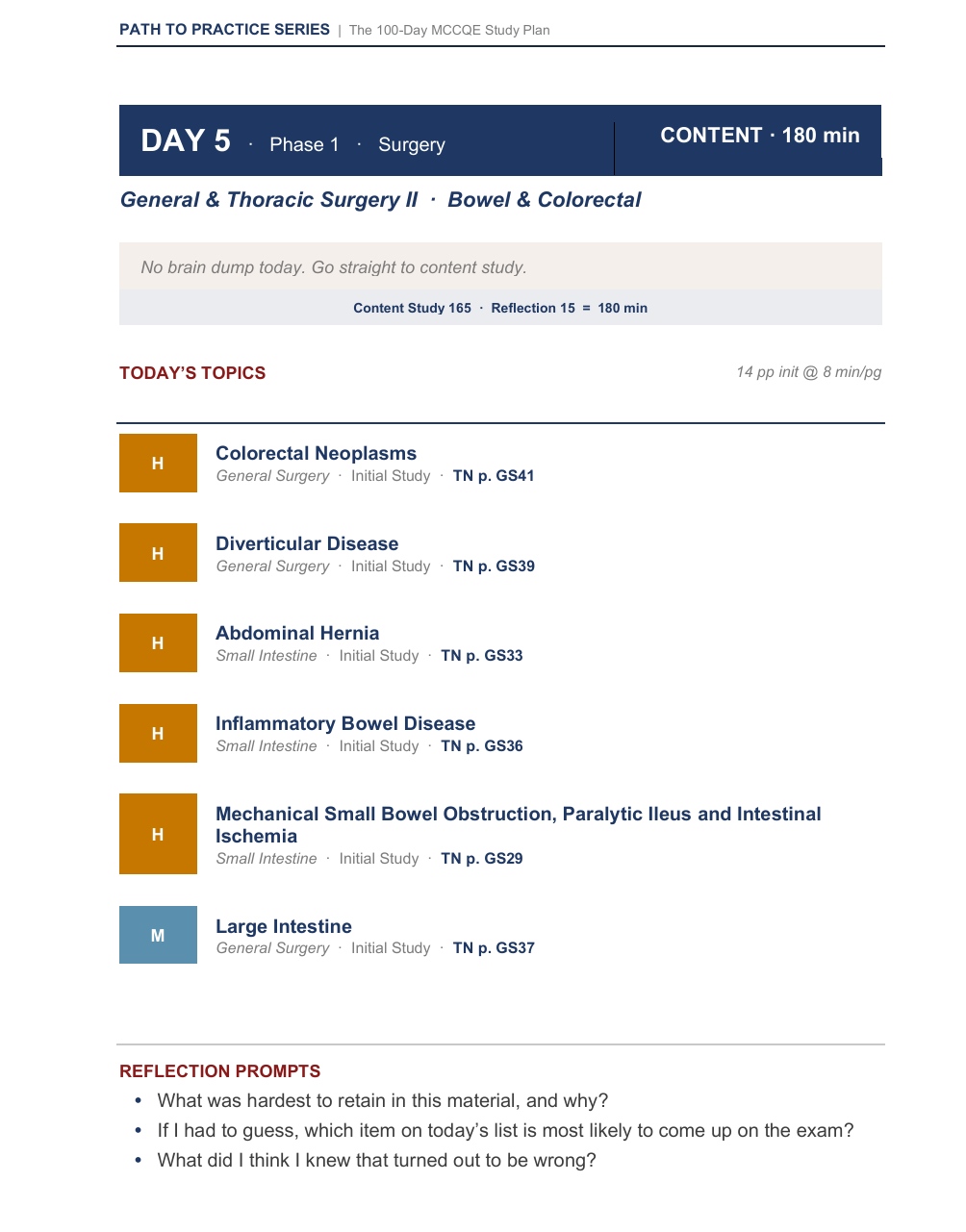
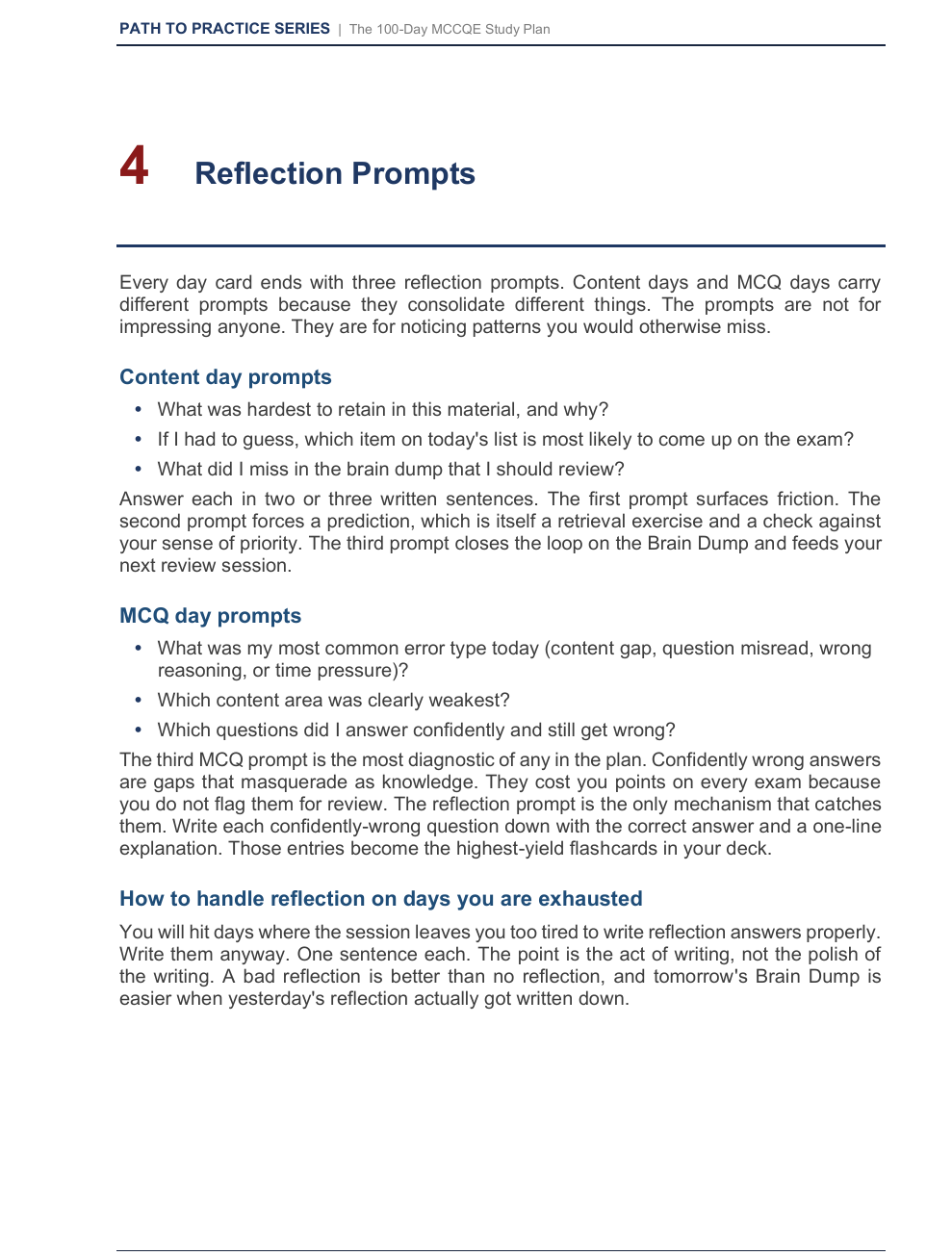
Reflection that compounds. Every day closes with three prompts that surface what was hardest to retain, what is most likely to appear on the exam, and what your Brain Dump missed. Reflection feeds your next review session a target list, not a vague feeling.
What’s inside
100 daily session cards. Each card names the discipline, the topics in priority order, and the resources to use. The card is the day. No daily decisions.
A wrong-answer analysis system. Every wrong MCQ gets tagged as one of four error types: a content gap (you did not know it), a question misread (you missed a keyword), wrong reasoning (you applied your knowledge incorrectly), or time pressure (you would have got it with more time). Each error type requires a different response. Most candidates answer every wrong question with “do more questions,” which only fixes one of the four. This system gives you the right response for each.
Direct integration with Ethics for MCCQE and NAC. Every PHELO day in the plan pulls specific chapters from the Ethics Book on a published schedule. Ethics is woven through the 100 days from Day 11 onward, not crammed into the last two weeks.
Topics Beyond Plan appendix. Low-priority topics that did not earn a scheduled slot. Reference, not homework. Use it only if you finish a discipline early or if your wrong-answer log keeps pointing at one specific weakness.
The 2-hour orientation recording
Included with the book. A complete walkthrough of how to run the plan: what the MCCQE actually rewards, why the architecture is built the way it is, how to run a Content day and an MCQ day, how to navigate the book, and how to recover when life disrupts the schedule. Most candidates buy study resources and use them incorrectly. The recording is the difference between owning the book and operating it.
This is for you if
- You are preparing for the MCCQE and want a daily plan, not a list of topics
- You already have, or are willing to buy, Toronto Notes 2025 and a primary QBank
- You learn better against a structured plan than from open-ended study
How to use it
The plan is 100 days, paced however you decide. Most candidates run it as 100 consecutive days. Some take a recovery day each week. The plan does not stipulate when you study, only what to study, in what order, and how the day is structured.
Best paired with
Toronto Notes 2025 (the primary reference, mapped page-by-page throughout the plan), Ethics for MCCQE and NAC (woven into PHELO days from Day 11), and a single primary QBank (UWorld, Canada QBank, or the MCC official products). The plan tells you when to use each one.
About the author
Dr. Filipe Santos is an anesthesiologist and Assistant Professor at the University of Toronto, where he teaches medical students and residents. He is the author of the Path to Practice Series.
Format: Digital PDF + 2-hour orientation recording Access: Instant access after purchase | No physical shipment.
Price: $89.98 CAD
Look Inside